🎉 Up to 70% Off Selected ItemsShop Sale

Couronne de laurier by Erté
Erté (Romain de Tirtoff)
1892-1990 | Russian-French
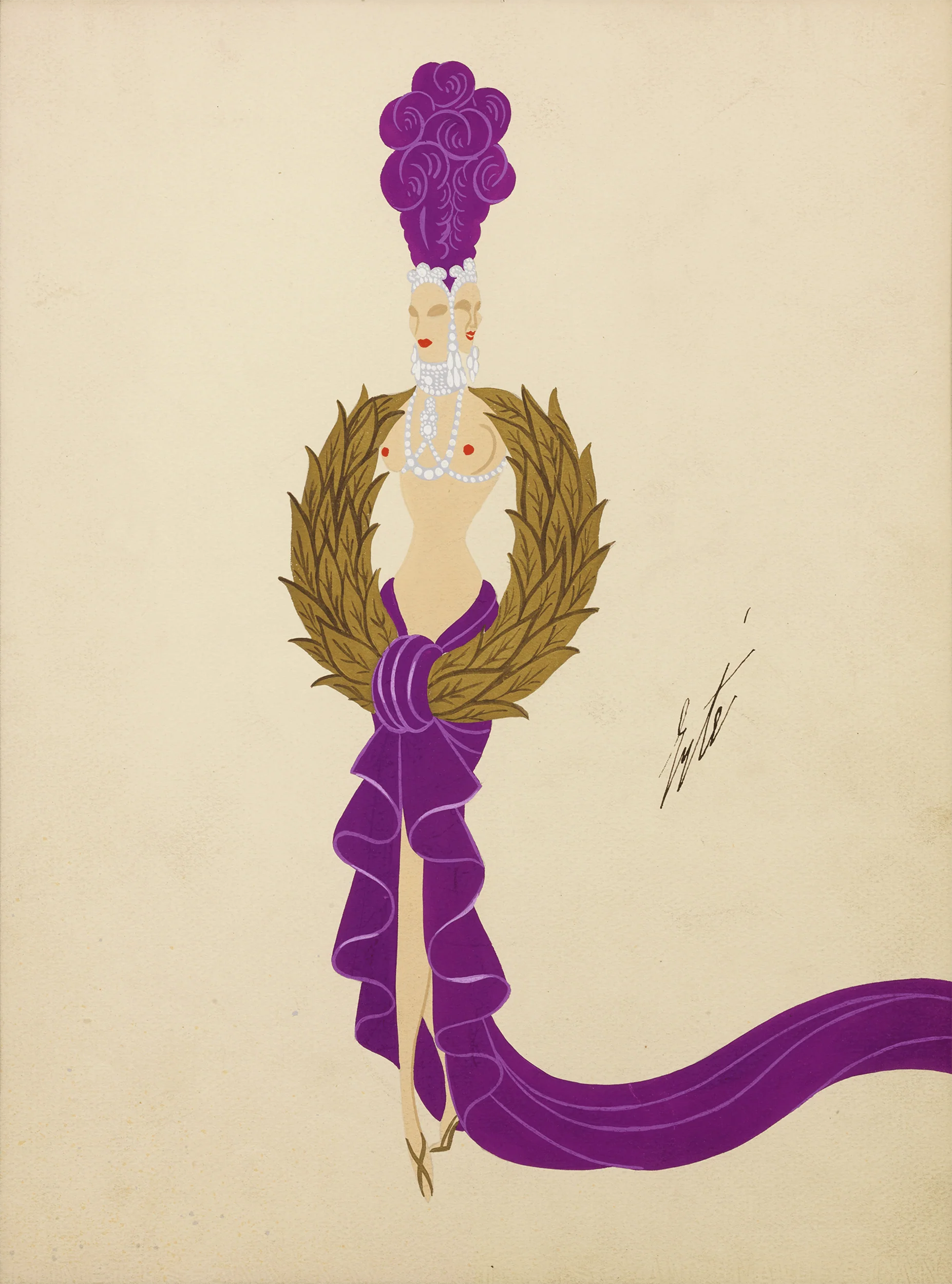
Couronne de laurier
The Laurel Wreath
Signed “Erté”(lower right)
Inscribed "No. 34.3" (en verso)
Gouache on paper
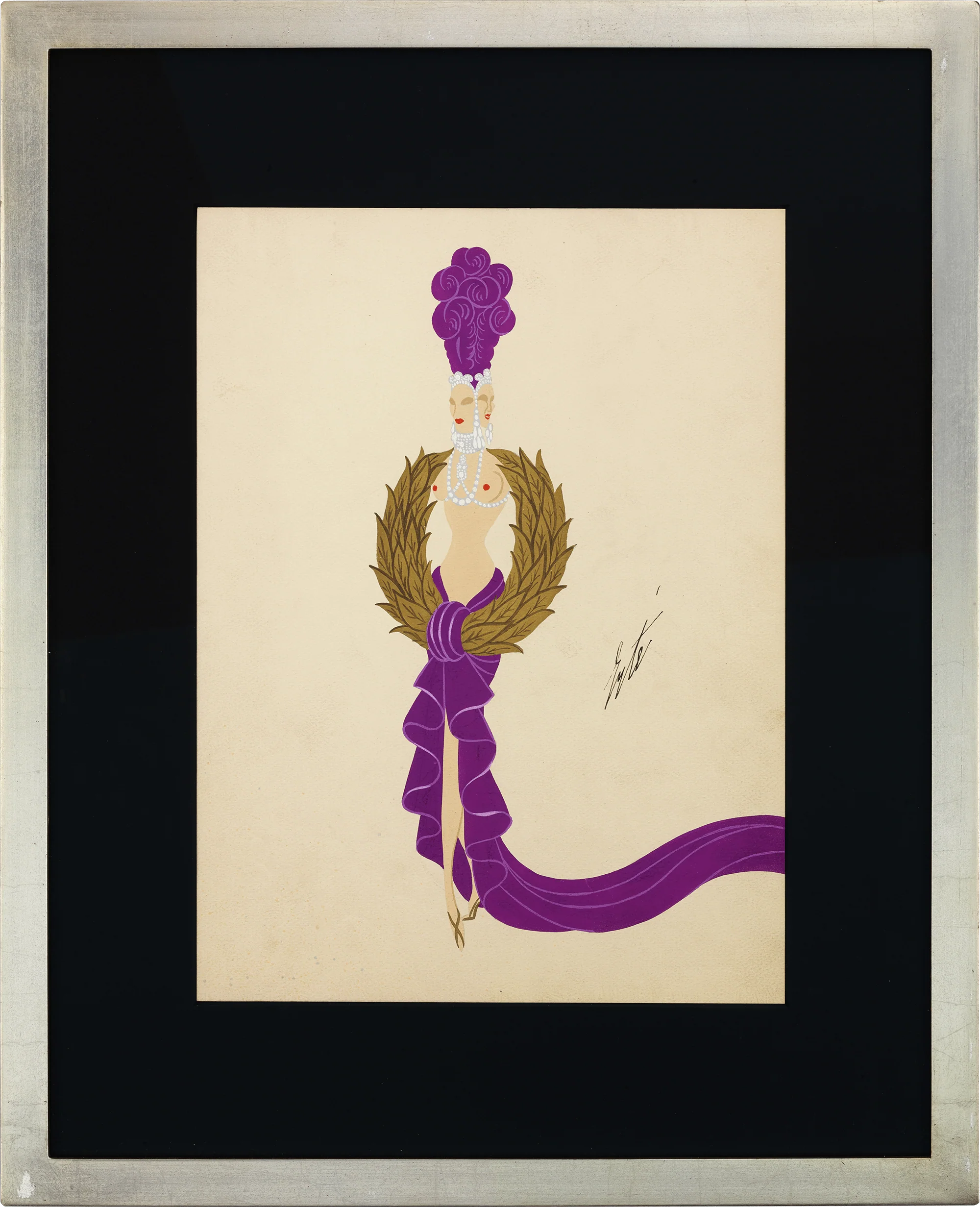
Erté conceived this extraordinarily imaginative costume featuring a laurel wreath for Jean Cocteau's renowned theatrical work, Les Monstres Sacrés. The play gained considerable acclaim and contributed to the widespread use of the French term "monstre sacré," denoting an individual of unparalleled excellence in their domain. The costume, envisioned by Erté, serves as an independent artistic expression, embellished with the laurel wreath — a classical emblem of victory and accomplishment. Complemented by a cascading skirt of purple fabric, the costume stands as a striking representation of Art Deco aesthetics.
The term "monster" in this context diverges from its conventional connotation of a fearsome creature. As a nod to the Classical motif of the laurel wreath, the term originates from the Latin word "monstrum," which carries multiple meanings, including "prodigy" and "divine omen." In English, one might liken it to a "giant," a term that similarly conveys both mythical and metaphorical significance.
Russian-French visionary Romain de Tirtoff (1892-1990), popularly known as Erté, began his artistic journey in the culturally rich city of St. Petersburg, where he developed an early fondness for ballet and theatrical performances. He moved to Paris in 1912 to study architecture, and quickly found his creative niche in crafting fantastical costumes for the city’s bustling nightlife. Erté‘s expertise, refined under the guidance of the famed Paul Poiret, captured the attention of Harper’s Bazaar, marking the beginning of a significant partnership that spanned from 1915 to 1936. The artist also designed sets for notable cinematic masterpieces including Ben Hur and La Bohème, and created sets and costumes for cabarets, operas and other performances at the Folies-Bergères, Bal Tabarin, the Théâtre du Bataclan and Le Casino de Paris. Often remembered as the “Father of Art Deco,” Erté was a trailblazer whose colorful creations shaped the groundbreaking Art Deco era more than any other, leaving an indelible mark on the history of art and design. His artworks reside in prestigious museum collections worldwide, including the Metropolitan Museum of Art in New York, the Victoria & Albert Museum in London and the Los Angeles County Museum of Art.
Circa 1939
Paper: 14” high by 10 1/2” wide
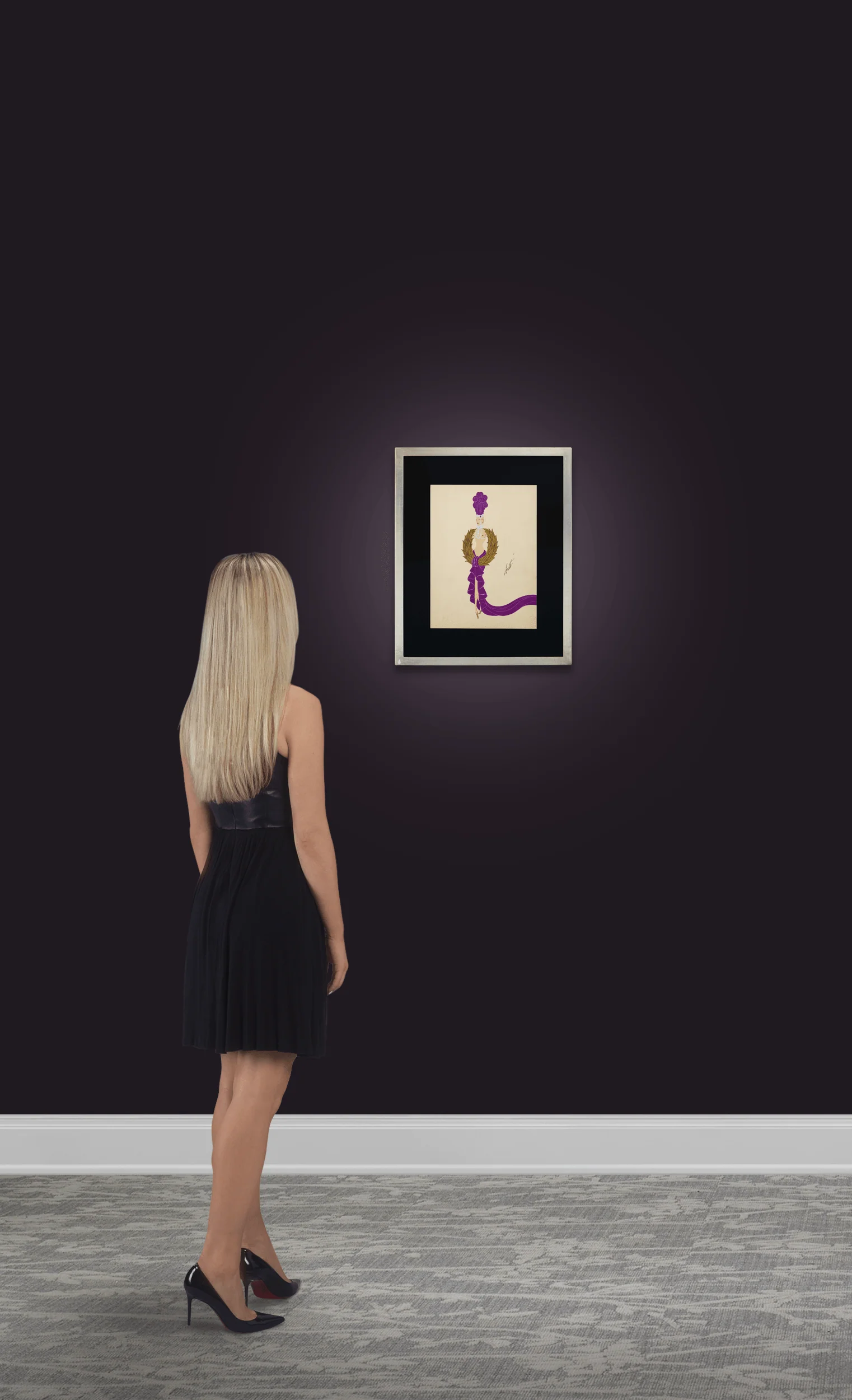
Frame: 20 3/4” high by 16 7/8” wide by 5/8" deep
Exhibitions:
M.S. Rau, New Orleans, Erté and the Era of Art Deco, October 14, 2023 - January 3, 2024
Provenance:
Private collection, Paris
M.S. Rau, New Orleans
1892-1990 | Russian-French
Couronne de laurier
The Laurel Wreath
Signed “Erté”(lower right)
Inscribed "No. 34.3" (en verso)
Gouache on paper
Erté conceived this extraordinarily imaginative costume featuring a laurel wreath for Jean Cocteau's renowned theatrical work, Les Monstres Sacrés. The play gained considerable acclaim and contributed to the widespread use of the French term "monstre sacré," denoting an individual of unparalleled excellence in their domain. The costume, envisioned by Erté, serves as an independent artistic expression, embellished with the laurel wreath — a classical emblem of victory and accomplishment. Complemented by a cascading skirt of purple fabric, the costume stands as a striking representation of Art Deco aesthetics.
The term "monster" in this context diverges from its conventional connotation of a fearsome creature. As a nod to the Classical motif of the laurel wreath, the term originates from the Latin word "monstrum," which carries multiple meanings, including "prodigy" and "divine omen." In English, one might liken it to a "giant," a term that similarly conveys both mythical and metaphorical significance.
Russian-French visionary Romain de Tirtoff (1892-1990), popularly known as Erté, began his artistic journey in the culturally rich city of St. Petersburg, where he developed an early fondness for ballet and theatrical performances. He moved to Paris in 1912 to study architecture, and quickly found his creative niche in crafting fantastical costumes for the city’s bustling nightlife. Erté‘s expertise, refined under the guidance of the famed Paul Poiret, captured the attention of Harper’s Bazaar, marking the beginning of a significant partnership that spanned from 1915 to 1936. The artist also designed sets for notable cinematic masterpieces including Ben Hur and La Bohème, and created sets and costumes for cabarets, operas and other performances at the Folies-Bergères, Bal Tabarin, the Théâtre du Bataclan and Le Casino de Paris. Often remembered as the “Father of Art Deco,” Erté was a trailblazer whose colorful creations shaped the groundbreaking Art Deco era more than any other, leaving an indelible mark on the history of art and design. His artworks reside in prestigious museum collections worldwide, including the Metropolitan Museum of Art in New York, the Victoria & Albert Museum in London and the Los Angeles County Museum of Art.
Circa 1939
Paper: 14” high by 10 1/2” wide
Frame: 20 3/4” high by 16 7/8” wide by 5/8" deep
Exhibitions:
M.S. Rau, New Orleans, Erté and the Era of Art Deco, October 14, 2023 - January 3, 2024
Provenance:
Private collection, Paris
M.S. Rau, New Orleans
$16,850.00
Couronne de laurier by Erté—
$16,850.00
Description
Erté (Romain de Tirtoff)
1892-1990 | Russian-French
Couronne de laurier
The Laurel Wreath
Signed “Erté”(lower right)
Inscribed "No. 34.3" (en verso)
Gouache on paper
Erté conceived this extraordinarily imaginative costume featuring a laurel wreath for Jean Cocteau's renowned theatrical work, Les Monstres Sacrés. The play gained considerable acclaim and contributed to the widespread use of the French term "monstre sacré," denoting an individual of unparalleled excellence in their domain. The costume, envisioned by Erté, serves as an independent artistic expression, embellished with the laurel wreath — a classical emblem of victory and accomplishment. Complemented by a cascading skirt of purple fabric, the costume stands as a striking representation of Art Deco aesthetics.
The term "monster" in this context diverges from its conventional connotation of a fearsome creature. As a nod to the Classical motif of the laurel wreath, the term originates from the Latin word "monstrum," which carries multiple meanings, including "prodigy" and "divine omen." In English, one might liken it to a "giant," a term that similarly conveys both mythical and metaphorical significance.
Russian-French visionary Romain de Tirtoff (1892-1990), popularly known as Erté, began his artistic journey in the culturally rich city of St. Petersburg, where he developed an early fondness for ballet and theatrical performances. He moved to Paris in 1912 to study architecture, and quickly found his creative niche in crafting fantastical costumes for the city’s bustling nightlife. Erté‘s expertise, refined under the guidance of the famed Paul Poiret, captured the attention of Harper’s Bazaar, marking the beginning of a significant partnership that spanned from 1915 to 1936. The artist also designed sets for notable cinematic masterpieces including Ben Hur and La Bohème, and created sets and costumes for cabarets, operas and other performances at the Folies-Bergères, Bal Tabarin, the Théâtre du Bataclan and Le Casino de Paris. Often remembered as the “Father of Art Deco,” Erté was a trailblazer whose colorful creations shaped the groundbreaking Art Deco era more than any other, leaving an indelible mark on the history of art and design. His artworks reside in prestigious museum collections worldwide, including the Metropolitan Museum of Art in New York, the Victoria & Albert Museum in London and the Los Angeles County Museum of Art.
Circa 1939
Paper: 14” high by 10 1/2” wide
Frame: 20 3/4” high by 16 7/8” wide by 5/8" deep
Exhibitions:
M.S. Rau, New Orleans, Erté and the Era of Art Deco, October 14, 2023 - January 3, 2024
Provenance:
Private collection, Paris
M.S. Rau, New Orleans
1892-1990 | Russian-French
Couronne de laurier
The Laurel Wreath
Signed “Erté”(lower right)
Inscribed "No. 34.3" (en verso)
Gouache on paper
Erté conceived this extraordinarily imaginative costume featuring a laurel wreath for Jean Cocteau's renowned theatrical work, Les Monstres Sacrés. The play gained considerable acclaim and contributed to the widespread use of the French term "monstre sacré," denoting an individual of unparalleled excellence in their domain. The costume, envisioned by Erté, serves as an independent artistic expression, embellished with the laurel wreath — a classical emblem of victory and accomplishment. Complemented by a cascading skirt of purple fabric, the costume stands as a striking representation of Art Deco aesthetics.
The term "monster" in this context diverges from its conventional connotation of a fearsome creature. As a nod to the Classical motif of the laurel wreath, the term originates from the Latin word "monstrum," which carries multiple meanings, including "prodigy" and "divine omen." In English, one might liken it to a "giant," a term that similarly conveys both mythical and metaphorical significance.
Russian-French visionary Romain de Tirtoff (1892-1990), popularly known as Erté, began his artistic journey in the culturally rich city of St. Petersburg, where he developed an early fondness for ballet and theatrical performances. He moved to Paris in 1912 to study architecture, and quickly found his creative niche in crafting fantastical costumes for the city’s bustling nightlife. Erté‘s expertise, refined under the guidance of the famed Paul Poiret, captured the attention of Harper’s Bazaar, marking the beginning of a significant partnership that spanned from 1915 to 1936. The artist also designed sets for notable cinematic masterpieces including Ben Hur and La Bohème, and created sets and costumes for cabarets, operas and other performances at the Folies-Bergères, Bal Tabarin, the Théâtre du Bataclan and Le Casino de Paris. Often remembered as the “Father of Art Deco,” Erté was a trailblazer whose colorful creations shaped the groundbreaking Art Deco era more than any other, leaving an indelible mark on the history of art and design. His artworks reside in prestigious museum collections worldwide, including the Metropolitan Museum of Art in New York, the Victoria & Albert Museum in London and the Los Angeles County Museum of Art.
Circa 1939
Paper: 14” high by 10 1/2” wide
Frame: 20 3/4” high by 16 7/8” wide by 5/8" deep
Exhibitions:
M.S. Rau, New Orleans, Erté and the Era of Art Deco, October 14, 2023 - January 3, 2024
Provenance:
Private collection, Paris
M.S. Rau, New Orleans