🎉 Up to 70% Off Selected ItemsShop Sale

Holland Circle by Baumann and Kinzelbach
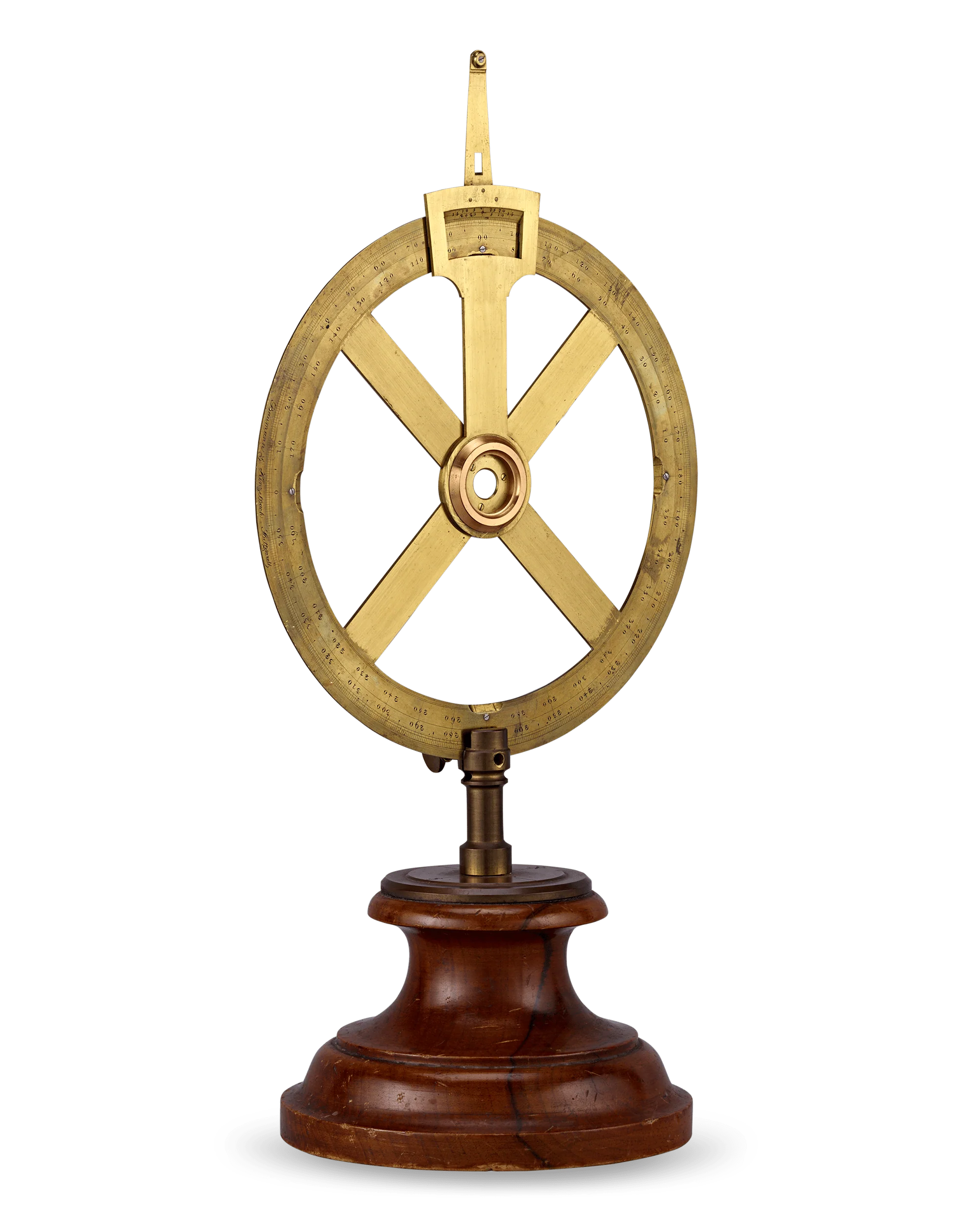
This intriguing item is almost certainly a Holland Circle by German scientific instrument makers Baumann & Kinzelbach. The Holland Circle, sometimes referred to as a Dutch Circle, was used in land surveying and is a precursor to the theodolite, an optical instrument for measuring angles. Baumann and Kinzelbach were based in Stuttgart, Germany, and in addition to crafting surveying instruments and compasses, also created a 2-foot tall "comet seeker" used at the Gotha Observatory near Gotha, Thuringia, Germany. Crafted from bronze with a handsome wooden stand and complete with its custom carrying case, this finely-calibrated instrument is a unique and elegant piece of scientific history.
Engraved "Baumann & Kinzelbach Stuttgardt"
Circa 1820
16 3/4” high x 8 1/8” wide x 8 1/8” deep
Case: 7/8" high x 9 1/4" wide x 11 1/2" deep
References:
Gotha- the Instruments of the observatory, 1988, by G. Wolfschmidt, pp. 89-90
Engraved "Baumann & Kinzelbach Stuttgardt"
Circa 1820
16 3/4” high x 8 1/8” wide x 8 1/8” deep
Case: 7/8" high x 9 1/4" wide x 11 1/2" deep
References:
Gotha- the Instruments of the observatory, 1988, by G. Wolfschmidt, pp. 89-90
$6,850.00
Holland Circle by Baumann and Kinzelbach—
$6,850.00



Description
This intriguing item is almost certainly a Holland Circle by German scientific instrument makers Baumann & Kinzelbach. The Holland Circle, sometimes referred to as a Dutch Circle, was used in land surveying and is a precursor to the theodolite, an optical instrument for measuring angles. Baumann and Kinzelbach were based in Stuttgart, Germany, and in addition to crafting surveying instruments and compasses, also created a 2-foot tall "comet seeker" used at the Gotha Observatory near Gotha, Thuringia, Germany. Crafted from bronze with a handsome wooden stand and complete with its custom carrying case, this finely-calibrated instrument is a unique and elegant piece of scientific history.
Engraved "Baumann & Kinzelbach Stuttgardt"
Circa 1820
16 3/4” high x 8 1/8” wide x 8 1/8” deep
Case: 7/8" high x 9 1/4" wide x 11 1/2" deep
References:
Gotha- the Instruments of the observatory, 1988, by G. Wolfschmidt, pp. 89-90
Engraved "Baumann & Kinzelbach Stuttgardt"
Circa 1820
16 3/4” high x 8 1/8” wide x 8 1/8” deep
Case: 7/8" high x 9 1/4" wide x 11 1/2" deep
References:
Gotha- the Instruments of the observatory, 1988, by G. Wolfschmidt, pp. 89-90