🎉 Up to 70% Off Selected ItemsShop Sale

Pair of Napoleon III Royal Rouge Griotte Athenienne
Royal Rouge Griotte Marble Athenienne
After Pierre Gouthière
Late 19th Century
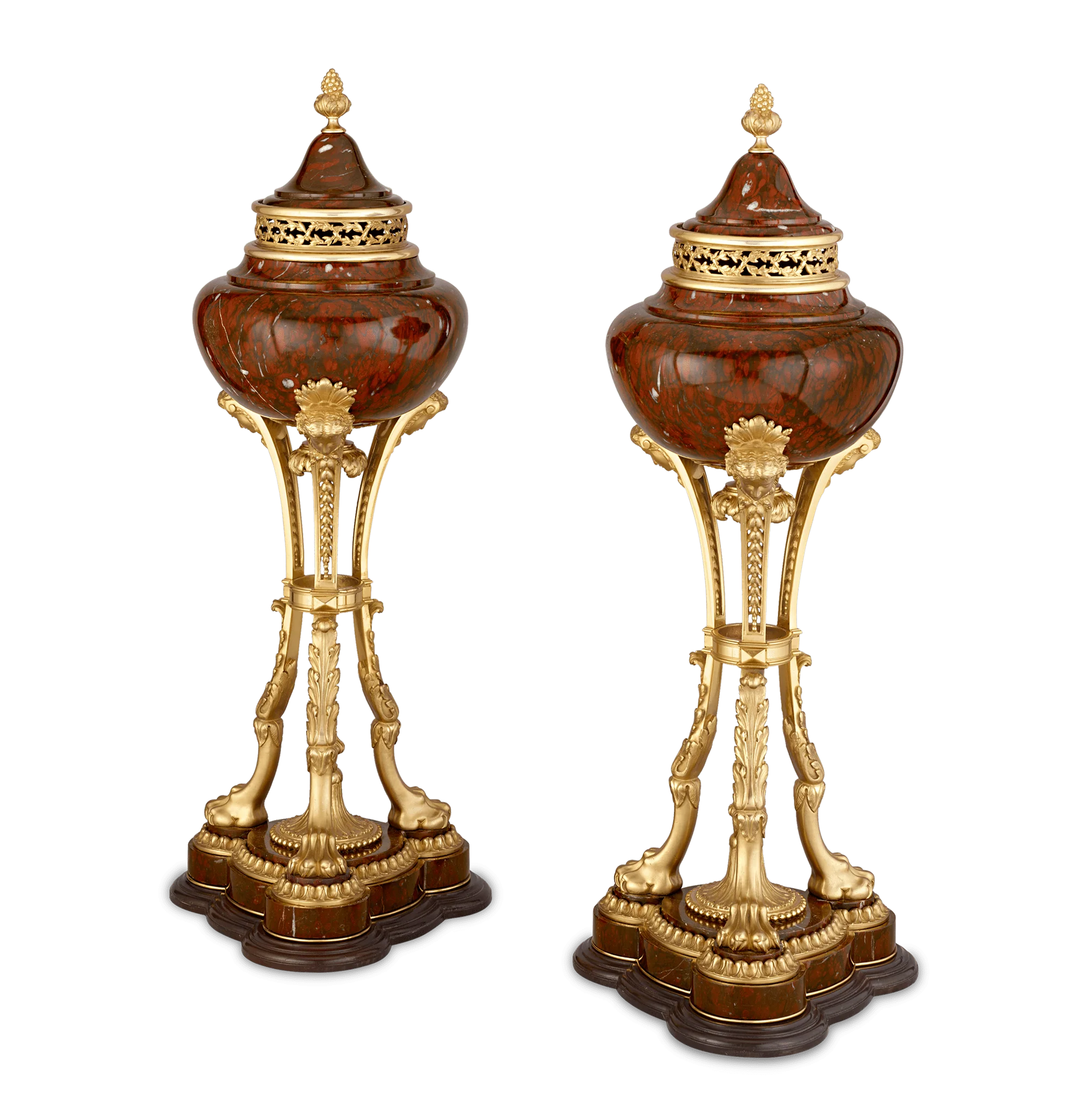
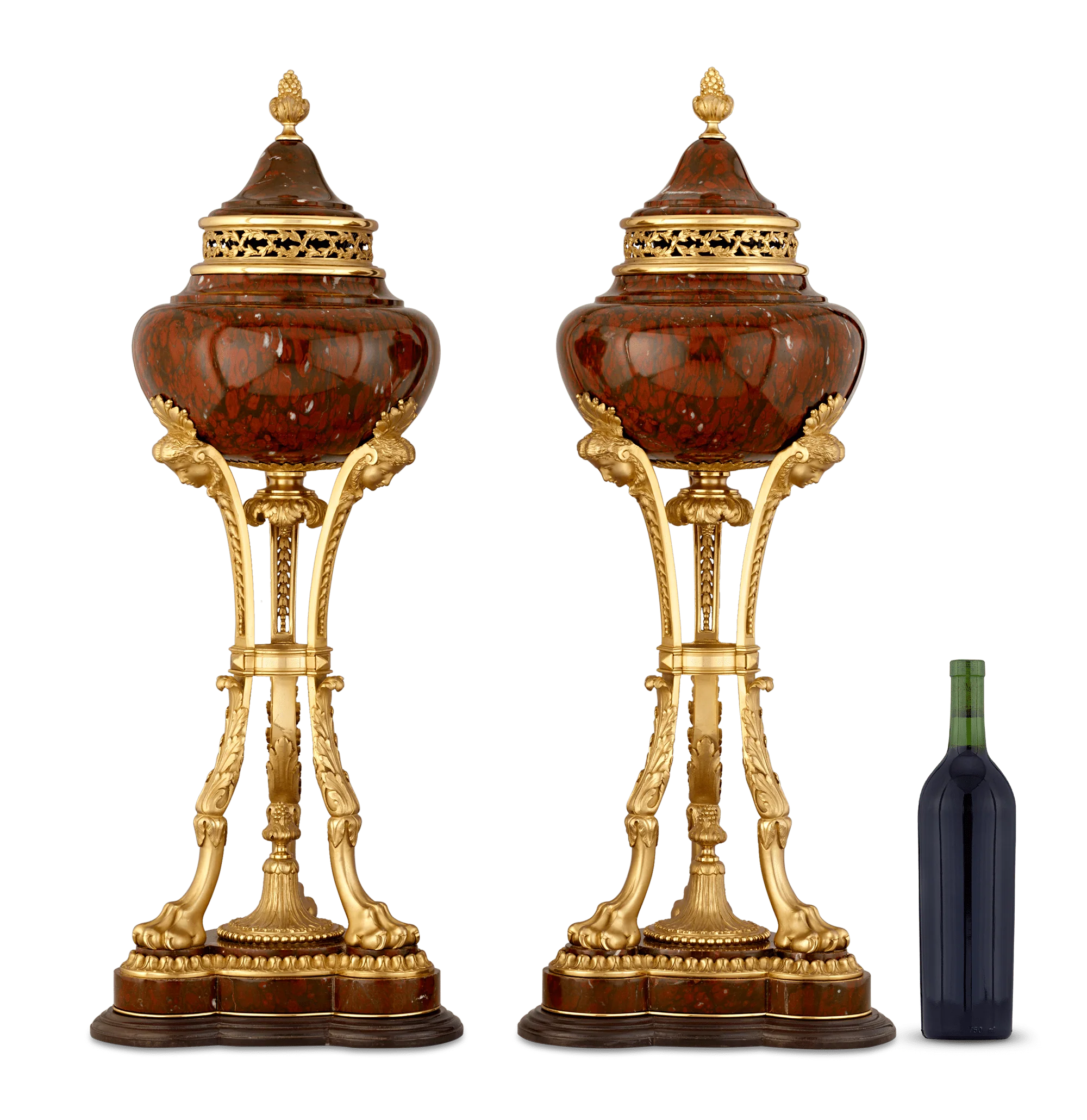
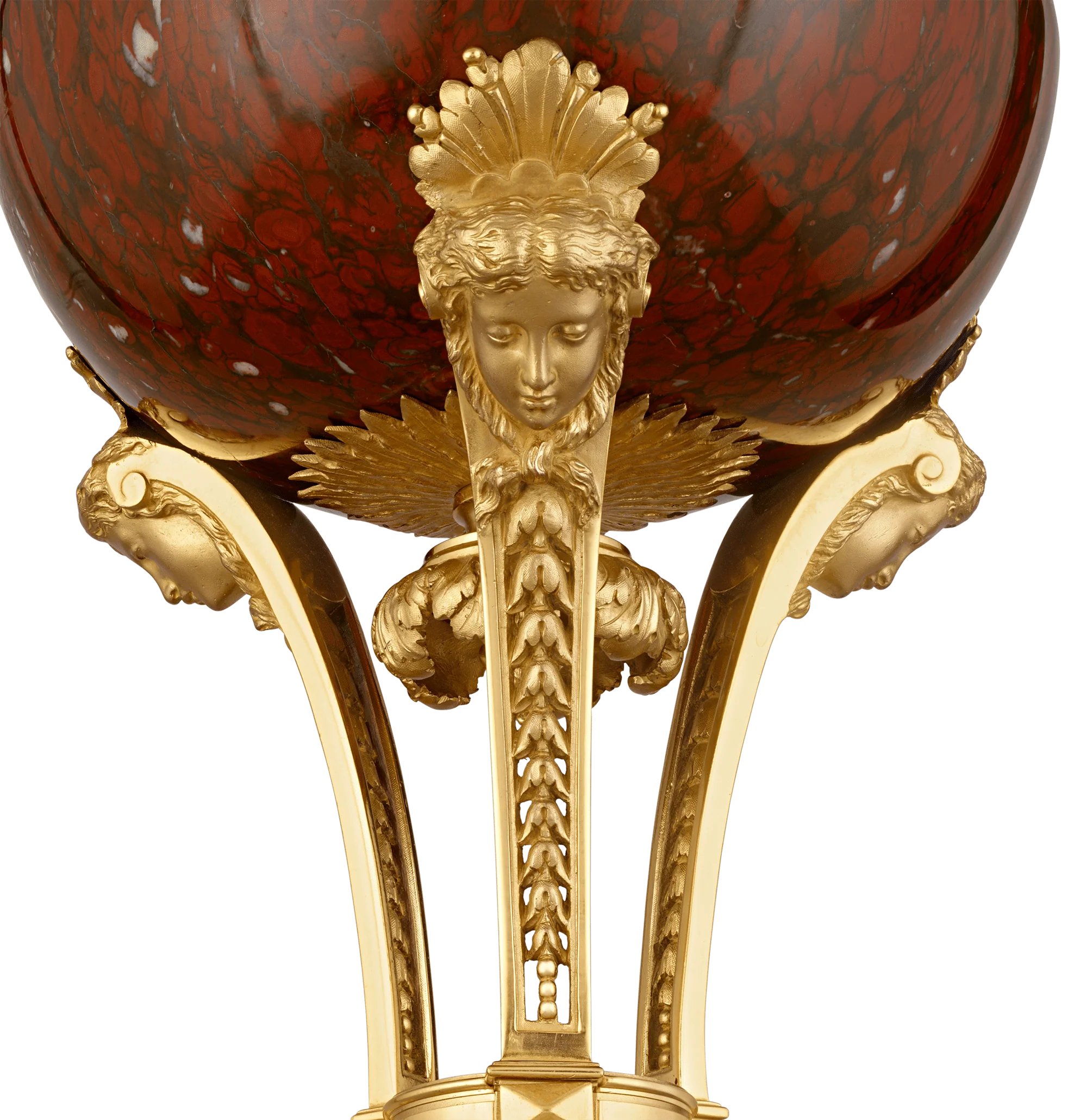
This monumental pair of Napoleon III gilt bronze-mounted Royal Rouge Griotte athenienne perfume vases epitomizes the splendor of 19th-century French artistry. Designed in the neoclassical palatial taste, these vases are crafted from the finest Royal Rouge Griotte marble, a rare and vibrant stone historically reserved for French royalty. Their superb gilt bronze mounts showcase intricate Greco-Roman motifs, including exquisitely detailed lion paw feet and masks, which contrast beautifully with the rich red marble. These magnificent works reflect the influence of Pierre Gouthière, the most celebrated Parisian chaser and gilder of his era.
The Royal Rouge Griotte marble, named after the Morello cherry ("griotte" in French) is a prestigious stone that often features fossilized goniatites filled with white calcite, creating a striking pattern referred to as "oeil de perdrix" (“partridge eye”). The quarries in the Caunes-Minervois and Félines-Minervois regions, northeast of Carcassonne, have a history dating back to Antiquity. Rediscovered in 1615 by Italian sculptors Stefano Sormano and Antoine Lignani, these quarries gained fame under the patronage of sculptor Bernini, who drew the attention of the French court. Declared "Royal Quarries" by decree in 1692, the marble became a hallmark of opulence, adorning the Palace of Versailles and other royal apartments. The stone used in this pair is among the finest examples of Royal Rouge Griotte marble.
28 1/2" high x 11 1/2" diameter
After Pierre Gouthière
Late 19th Century
This monumental pair of Napoleon III gilt bronze-mounted Royal Rouge Griotte athenienne perfume vases epitomizes the splendor of 19th-century French artistry. Designed in the neoclassical palatial taste, these vases are crafted from the finest Royal Rouge Griotte marble, a rare and vibrant stone historically reserved for French royalty. Their superb gilt bronze mounts showcase intricate Greco-Roman motifs, including exquisitely detailed lion paw feet and masks, which contrast beautifully with the rich red marble. These magnificent works reflect the influence of Pierre Gouthière, the most celebrated Parisian chaser and gilder of his era.
The Royal Rouge Griotte marble, named after the Morello cherry ("griotte" in French) is a prestigious stone that often features fossilized goniatites filled with white calcite, creating a striking pattern referred to as "oeil de perdrix" (“partridge eye”). The quarries in the Caunes-Minervois and Félines-Minervois regions, northeast of Carcassonne, have a history dating back to Antiquity. Rediscovered in 1615 by Italian sculptors Stefano Sormano and Antoine Lignani, these quarries gained fame under the patronage of sculptor Bernini, who drew the attention of the French court. Declared "Royal Quarries" by decree in 1692, the marble became a hallmark of opulence, adorning the Palace of Versailles and other royal apartments. The stone used in this pair is among the finest examples of Royal Rouge Griotte marble.
28 1/2" high x 11 1/2" diameter
$38,850.00
Pair of Napoleon III Royal Rouge Griotte Athenienne—
$38,850.00


Description
Royal Rouge Griotte Marble Athenienne
After Pierre Gouthière
Late 19th Century
This monumental pair of Napoleon III gilt bronze-mounted Royal Rouge Griotte athenienne perfume vases epitomizes the splendor of 19th-century French artistry. Designed in the neoclassical palatial taste, these vases are crafted from the finest Royal Rouge Griotte marble, a rare and vibrant stone historically reserved for French royalty. Their superb gilt bronze mounts showcase intricate Greco-Roman motifs, including exquisitely detailed lion paw feet and masks, which contrast beautifully with the rich red marble. These magnificent works reflect the influence of Pierre Gouthière, the most celebrated Parisian chaser and gilder of his era.
The Royal Rouge Griotte marble, named after the Morello cherry ("griotte" in French) is a prestigious stone that often features fossilized goniatites filled with white calcite, creating a striking pattern referred to as "oeil de perdrix" (“partridge eye”). The quarries in the Caunes-Minervois and Félines-Minervois regions, northeast of Carcassonne, have a history dating back to Antiquity. Rediscovered in 1615 by Italian sculptors Stefano Sormano and Antoine Lignani, these quarries gained fame under the patronage of sculptor Bernini, who drew the attention of the French court. Declared "Royal Quarries" by decree in 1692, the marble became a hallmark of opulence, adorning the Palace of Versailles and other royal apartments. The stone used in this pair is among the finest examples of Royal Rouge Griotte marble.
28 1/2" high x 11 1/2" diameter
After Pierre Gouthière
Late 19th Century
This monumental pair of Napoleon III gilt bronze-mounted Royal Rouge Griotte athenienne perfume vases epitomizes the splendor of 19th-century French artistry. Designed in the neoclassical palatial taste, these vases are crafted from the finest Royal Rouge Griotte marble, a rare and vibrant stone historically reserved for French royalty. Their superb gilt bronze mounts showcase intricate Greco-Roman motifs, including exquisitely detailed lion paw feet and masks, which contrast beautifully with the rich red marble. These magnificent works reflect the influence of Pierre Gouthière, the most celebrated Parisian chaser and gilder of his era.
The Royal Rouge Griotte marble, named after the Morello cherry ("griotte" in French) is a prestigious stone that often features fossilized goniatites filled with white calcite, creating a striking pattern referred to as "oeil de perdrix" (“partridge eye”). The quarries in the Caunes-Minervois and Félines-Minervois regions, northeast of Carcassonne, have a history dating back to Antiquity. Rediscovered in 1615 by Italian sculptors Stefano Sormano and Antoine Lignani, these quarries gained fame under the patronage of sculptor Bernini, who drew the attention of the French court. Declared "Royal Quarries" by decree in 1692, the marble became a hallmark of opulence, adorning the Palace of Versailles and other royal apartments. The stone used in this pair is among the finest examples of Royal Rouge Griotte marble.
28 1/2" high x 11 1/2" diameter