🎉 Up to 70% Off Selected ItemsShop Sale

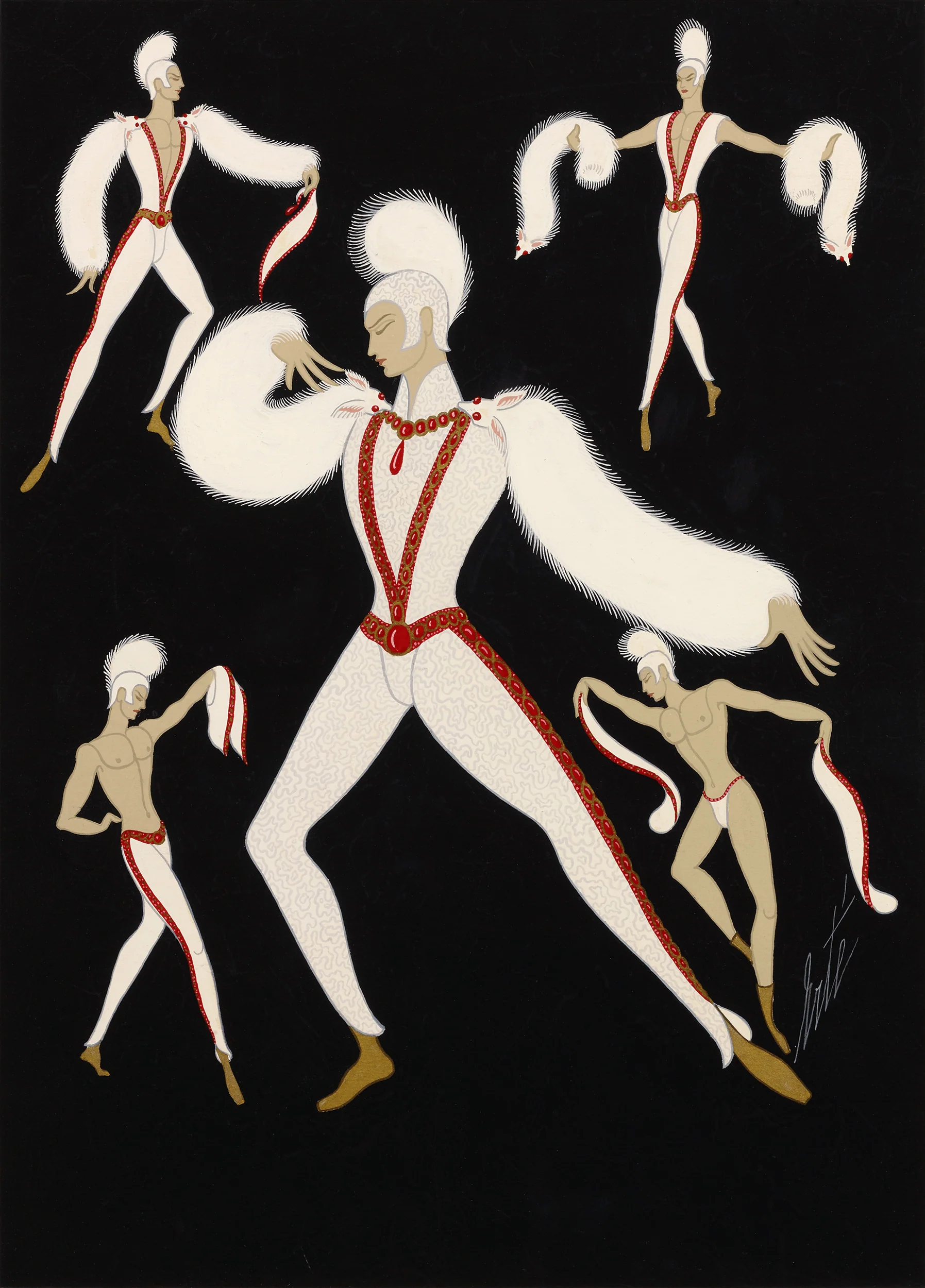
Quatre danseurs renard by Erté
Erté (Romain de Tirtoff)
1892-1990 | Russian-French
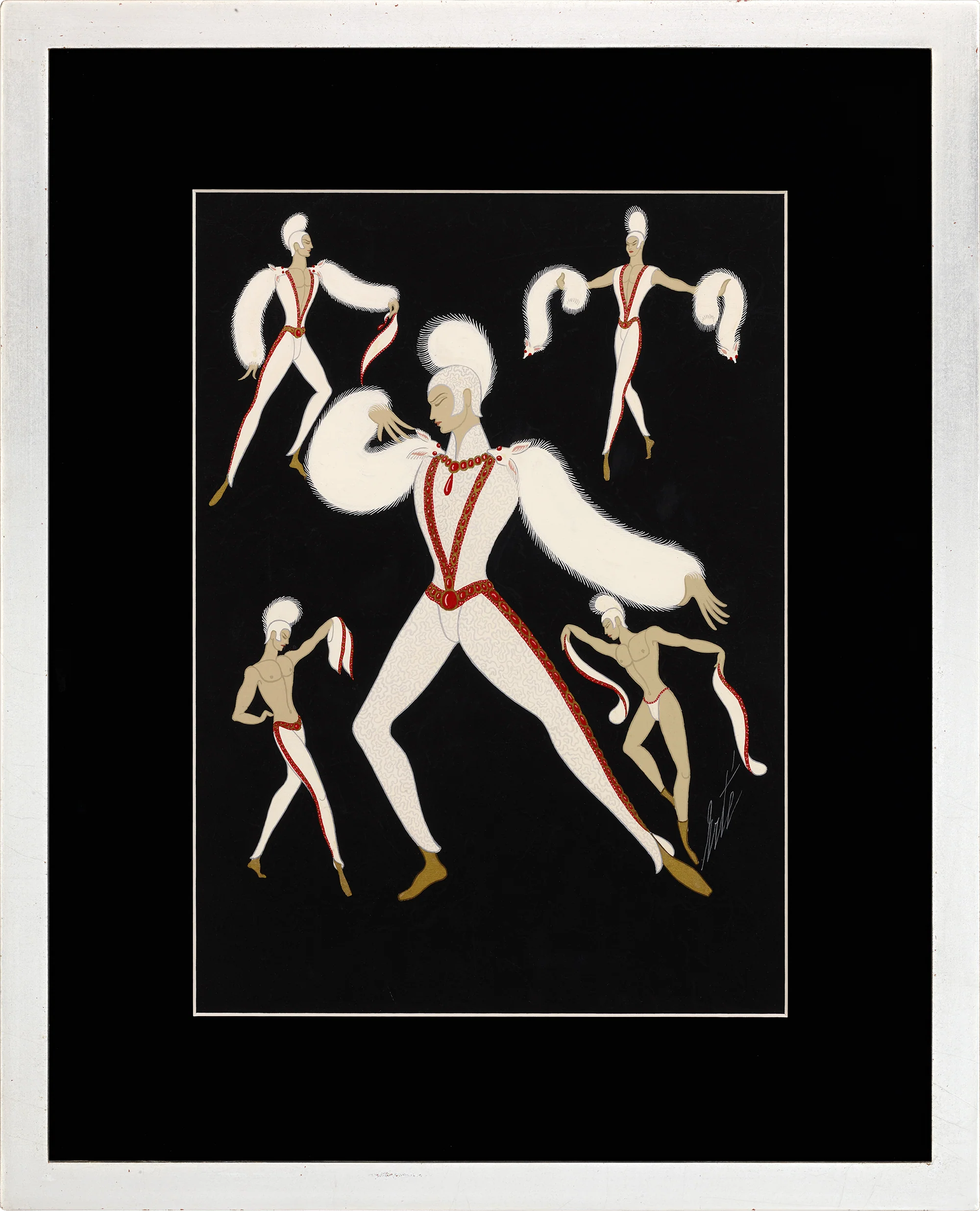
Quatre danseurs renard
(Four fox dancers)
Signed “Erté” (lower right)
Inscribed “n°18.181” (en verso)
Roland Petit was a transformative figure in 20th-century ballet, known for infusing contemporary and theatrical elements into classical ballet traditions. Petit’s innovative choreographies brought him great renown and celebrity, and his partnerships with Erté were characterized by a harmonious synthesis of dance and visual spectacle. In Quatre danseurs renard, Erté designs four whimsical yet glamorous fox costumes for Petit's show.
The alliance between Erté and the flourishing performing arts scene of Paris transported audiences to new realms throughout the early 20th century. Erté quickly forged relationships with luminaries of the performing arts world — including Zizi Jeanmaire, Roland Petit and Misinguett — and leant his distinctive Art Deco vision to operatic and theater productions. These collaborations rose above mere aesthetic embellishments, penetrating the core of performances and adding greater depth to the narratives on display. The artist possessed a great range of vision and was equally adept at capturing Rococo decadence in the sets of Cosi Fan Tutti as he was in creating supernatural, moody interiors for Les Mamelles de Tirésias. His Art Deco stylings brought both a fantasy and modernity to the stage that has rarely been matched since.
Russian-French visionary Romain de Tirtoff (1892-1990), popularly known as Erté, began his artistic journey in the culturally rich city of St. Petersburg, where he developed an early fondness for ballet and theatrical performances. He moved to Paris in 1912 to study architecture, and quickly found his creative niche in crafting fantastical costumes for the city’s bustling nightlife. Erté‘s expertise, refined under the guidance of the famed Paul Poiret, captured the attention of Harper’s Bazaar, marking the beginning of a significant partnership that spanned from 1915 to 1936. The artist also designed sets for notable cinematic masterpieces including Ben Hur and La Bohème, and created sets and costumes for cabarets, operas and other performances at the Folies-Bergères, Bal Tabarin, the Théâtre du Bataclan and Le Casino de Paris. Erté was a trailblazer whose colorful creations shaped the groundbreaking Art Deco era more than any other, leaving an indelible mark on the history of art and design. His artworks reside in prestigious museum collections worldwide, including the Metropolitan Museum of Art in New York, the Victoria & Albert Museum in London and the Los Angeles County Museum of Art.
Painted 1969
Paper: 14" high x 10” wide
Frame: 21" high x 17" wide x 5/8" deep
Provenance:
Private collection, Paris
M.S. Rau, New Orleans
Exhibitions:
M.S. Rau, New Orleans, Erté and the Era of Art Deco, October 14, 2023 - January 3, 2024
1892-1990 | Russian-French
Quatre danseurs renard
(Four fox dancers)
Signed “Erté” (lower right)
Inscribed “n°18.181” (en verso)
Roland Petit was a transformative figure in 20th-century ballet, known for infusing contemporary and theatrical elements into classical ballet traditions. Petit’s innovative choreographies brought him great renown and celebrity, and his partnerships with Erté were characterized by a harmonious synthesis of dance and visual spectacle. In Quatre danseurs renard, Erté designs four whimsical yet glamorous fox costumes for Petit's show.
The alliance between Erté and the flourishing performing arts scene of Paris transported audiences to new realms throughout the early 20th century. Erté quickly forged relationships with luminaries of the performing arts world — including Zizi Jeanmaire, Roland Petit and Misinguett — and leant his distinctive Art Deco vision to operatic and theater productions. These collaborations rose above mere aesthetic embellishments, penetrating the core of performances and adding greater depth to the narratives on display. The artist possessed a great range of vision and was equally adept at capturing Rococo decadence in the sets of Cosi Fan Tutti as he was in creating supernatural, moody interiors for Les Mamelles de Tirésias. His Art Deco stylings brought both a fantasy and modernity to the stage that has rarely been matched since.
Russian-French visionary Romain de Tirtoff (1892-1990), popularly known as Erté, began his artistic journey in the culturally rich city of St. Petersburg, where he developed an early fondness for ballet and theatrical performances. He moved to Paris in 1912 to study architecture, and quickly found his creative niche in crafting fantastical costumes for the city’s bustling nightlife. Erté‘s expertise, refined under the guidance of the famed Paul Poiret, captured the attention of Harper’s Bazaar, marking the beginning of a significant partnership that spanned from 1915 to 1936. The artist also designed sets for notable cinematic masterpieces including Ben Hur and La Bohème, and created sets and costumes for cabarets, operas and other performances at the Folies-Bergères, Bal Tabarin, the Théâtre du Bataclan and Le Casino de Paris. Erté was a trailblazer whose colorful creations shaped the groundbreaking Art Deco era more than any other, leaving an indelible mark on the history of art and design. His artworks reside in prestigious museum collections worldwide, including the Metropolitan Museum of Art in New York, the Victoria & Albert Museum in London and the Los Angeles County Museum of Art.
Painted 1969
Paper: 14" high x 10” wide
Frame: 21" high x 17" wide x 5/8" deep
Provenance:
Private collection, Paris
M.S. Rau, New Orleans
Exhibitions:
M.S. Rau, New Orleans, Erté and the Era of Art Deco, October 14, 2023 - January 3, 2024
$24,500.00
Quatre danseurs renard by Erté—
$24,500.00
Description
Erté (Romain de Tirtoff)
1892-1990 | Russian-French
Quatre danseurs renard
(Four fox dancers)
Signed “Erté” (lower right)
Inscribed “n°18.181” (en verso)
Roland Petit was a transformative figure in 20th-century ballet, known for infusing contemporary and theatrical elements into classical ballet traditions. Petit’s innovative choreographies brought him great renown and celebrity, and his partnerships with Erté were characterized by a harmonious synthesis of dance and visual spectacle. In Quatre danseurs renard, Erté designs four whimsical yet glamorous fox costumes for Petit's show.
The alliance between Erté and the flourishing performing arts scene of Paris transported audiences to new realms throughout the early 20th century. Erté quickly forged relationships with luminaries of the performing arts world — including Zizi Jeanmaire, Roland Petit and Misinguett — and leant his distinctive Art Deco vision to operatic and theater productions. These collaborations rose above mere aesthetic embellishments, penetrating the core of performances and adding greater depth to the narratives on display. The artist possessed a great range of vision and was equally adept at capturing Rococo decadence in the sets of Cosi Fan Tutti as he was in creating supernatural, moody interiors for Les Mamelles de Tirésias. His Art Deco stylings brought both a fantasy and modernity to the stage that has rarely been matched since.
Russian-French visionary Romain de Tirtoff (1892-1990), popularly known as Erté, began his artistic journey in the culturally rich city of St. Petersburg, where he developed an early fondness for ballet and theatrical performances. He moved to Paris in 1912 to study architecture, and quickly found his creative niche in crafting fantastical costumes for the city’s bustling nightlife. Erté‘s expertise, refined under the guidance of the famed Paul Poiret, captured the attention of Harper’s Bazaar, marking the beginning of a significant partnership that spanned from 1915 to 1936. The artist also designed sets for notable cinematic masterpieces including Ben Hur and La Bohème, and created sets and costumes for cabarets, operas and other performances at the Folies-Bergères, Bal Tabarin, the Théâtre du Bataclan and Le Casino de Paris. Erté was a trailblazer whose colorful creations shaped the groundbreaking Art Deco era more than any other, leaving an indelible mark on the history of art and design. His artworks reside in prestigious museum collections worldwide, including the Metropolitan Museum of Art in New York, the Victoria & Albert Museum in London and the Los Angeles County Museum of Art.
Painted 1969
Paper: 14" high x 10” wide
Frame: 21" high x 17" wide x 5/8" deep
Provenance:
Private collection, Paris
M.S. Rau, New Orleans
Exhibitions:
M.S. Rau, New Orleans, Erté and the Era of Art Deco, October 14, 2023 - January 3, 2024
1892-1990 | Russian-French
Quatre danseurs renard
(Four fox dancers)
Signed “Erté” (lower right)
Inscribed “n°18.181” (en verso)
Roland Petit was a transformative figure in 20th-century ballet, known for infusing contemporary and theatrical elements into classical ballet traditions. Petit’s innovative choreographies brought him great renown and celebrity, and his partnerships with Erté were characterized by a harmonious synthesis of dance and visual spectacle. In Quatre danseurs renard, Erté designs four whimsical yet glamorous fox costumes for Petit's show.
The alliance between Erté and the flourishing performing arts scene of Paris transported audiences to new realms throughout the early 20th century. Erté quickly forged relationships with luminaries of the performing arts world — including Zizi Jeanmaire, Roland Petit and Misinguett — and leant his distinctive Art Deco vision to operatic and theater productions. These collaborations rose above mere aesthetic embellishments, penetrating the core of performances and adding greater depth to the narratives on display. The artist possessed a great range of vision and was equally adept at capturing Rococo decadence in the sets of Cosi Fan Tutti as he was in creating supernatural, moody interiors for Les Mamelles de Tirésias. His Art Deco stylings brought both a fantasy and modernity to the stage that has rarely been matched since.
Russian-French visionary Romain de Tirtoff (1892-1990), popularly known as Erté, began his artistic journey in the culturally rich city of St. Petersburg, where he developed an early fondness for ballet and theatrical performances. He moved to Paris in 1912 to study architecture, and quickly found his creative niche in crafting fantastical costumes for the city’s bustling nightlife. Erté‘s expertise, refined under the guidance of the famed Paul Poiret, captured the attention of Harper’s Bazaar, marking the beginning of a significant partnership that spanned from 1915 to 1936. The artist also designed sets for notable cinematic masterpieces including Ben Hur and La Bohème, and created sets and costumes for cabarets, operas and other performances at the Folies-Bergères, Bal Tabarin, the Théâtre du Bataclan and Le Casino de Paris. Erté was a trailblazer whose colorful creations shaped the groundbreaking Art Deco era more than any other, leaving an indelible mark on the history of art and design. His artworks reside in prestigious museum collections worldwide, including the Metropolitan Museum of Art in New York, the Victoria & Albert Museum in London and the Los Angeles County Museum of Art.
Painted 1969
Paper: 14" high x 10” wide
Frame: 21" high x 17" wide x 5/8" deep
Provenance:
Private collection, Paris
M.S. Rau, New Orleans
Exhibitions:
M.S. Rau, New Orleans, Erté and the Era of Art Deco, October 14, 2023 - January 3, 2024