🎉 Up to 70% Off Selected ItemsShop Sale

Silver Ship’s Bell for Sir William Bentley Purchase of Operation Mincemeat
Silver Ship’s Bell
Presented to Sir William Bentley Purchase
Bell made in 1944, presented in 1958
This remarkable artifact of Second World War history is the silver ship’s bell presented to Sir William Bentley Purchase, the British coroner who played a pivotal role in Operation Mincemeat, one of the most effective intelligence deceptions of the conflict. Commissioned during wartime by the Royal Navy, the bell stands as a rare testament to an operation that altered the course of the Mediterranean campaign by diverting German forces away from Sicily.
Purchase, coroner to the Royal Household, was discreetly called upon by Naval Intelligence in early 1943 to assist in an unprecedented deception. His task was to locate a recently deceased individual whose death would raise no suspicion and whose physical characteristics aligned with those of a staff officer. The body he selected became “Acting Major William Martin,” the fictitious Royal Marines officer, whose cleverly forged documents convinced German intelligence that the materials he carried were genuine.
The selection of the body was no simple task. Previous wartime attempts to use disguised corpses had heightened suspicion, and Naval Intelligence required someone recently deceased, with no visible cause of death, whose passing would not prompt inquiries. On January 28, 1943, Purchase located the ideal candidate: Glyndwr Michael, an unhoused man who died after ingesting rat poison and who was never reported missing. His slight build also suited the profile of a staff officer, and the poison left no trace after what appeared to be several days at sea.
Intelligence officers then constructed a complete identity for “Acting Major William Martin,” dressing the body in battledress and equipping it with convincing personal effects: a photograph of a fictional fiancée, an engagement ring receipt, a family letter and an overdraft notice. Most important were the forged documents outlining Allied plans. The deception worked precisely as intended. German units shifted to Greece and Sardinia, leaving Sicily—the Allies’ actual target—comparatively unprotected.
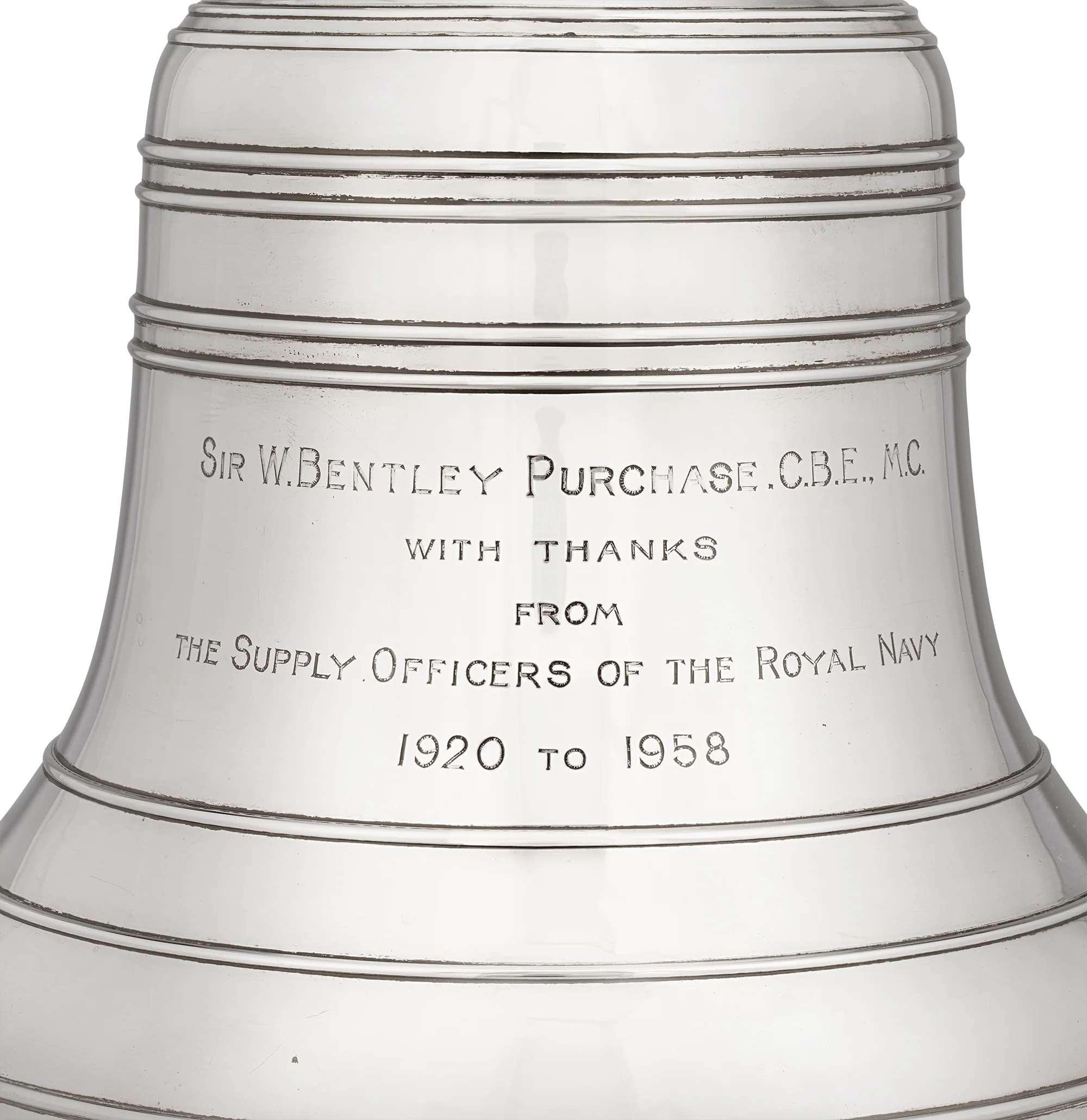
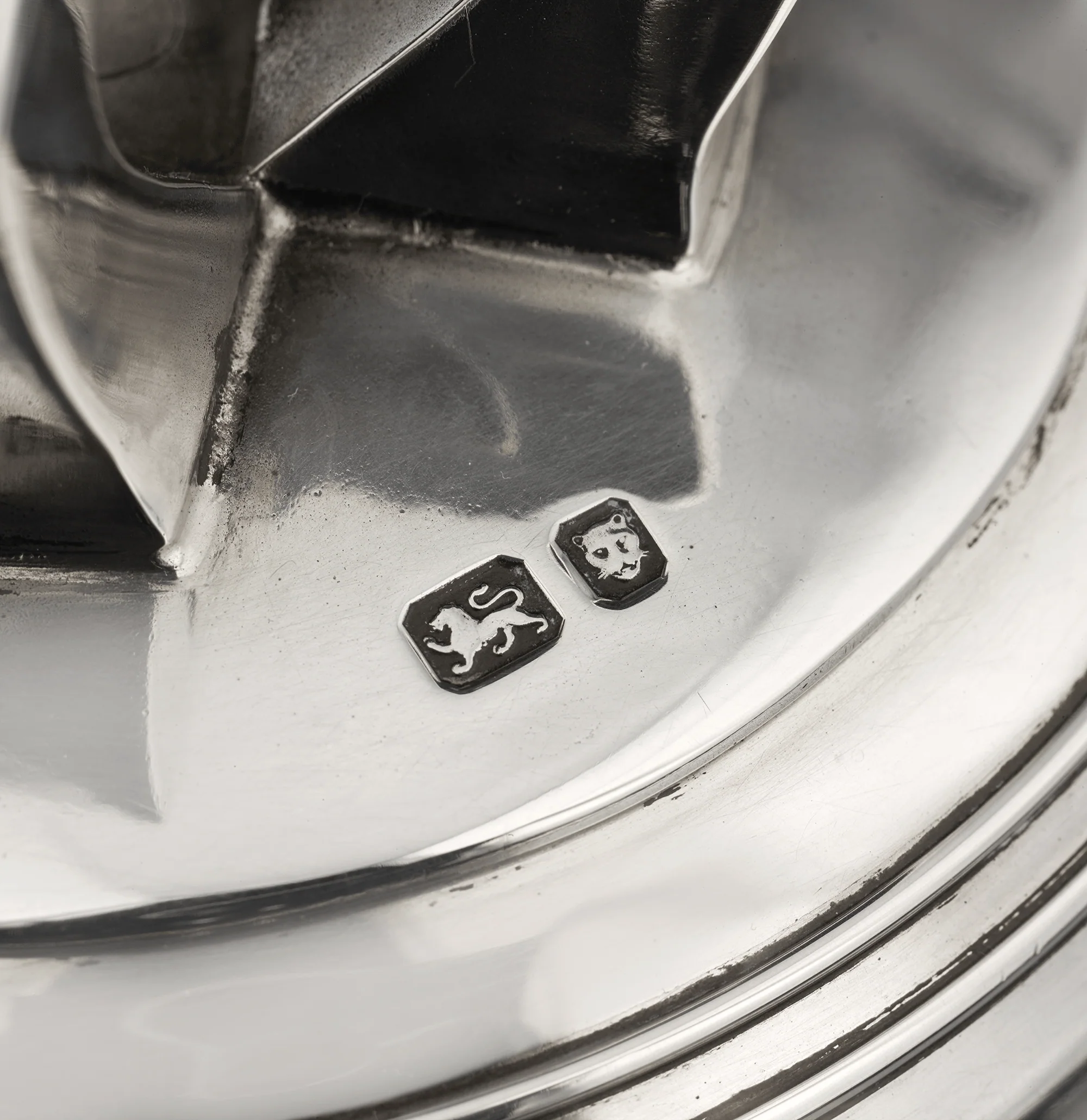
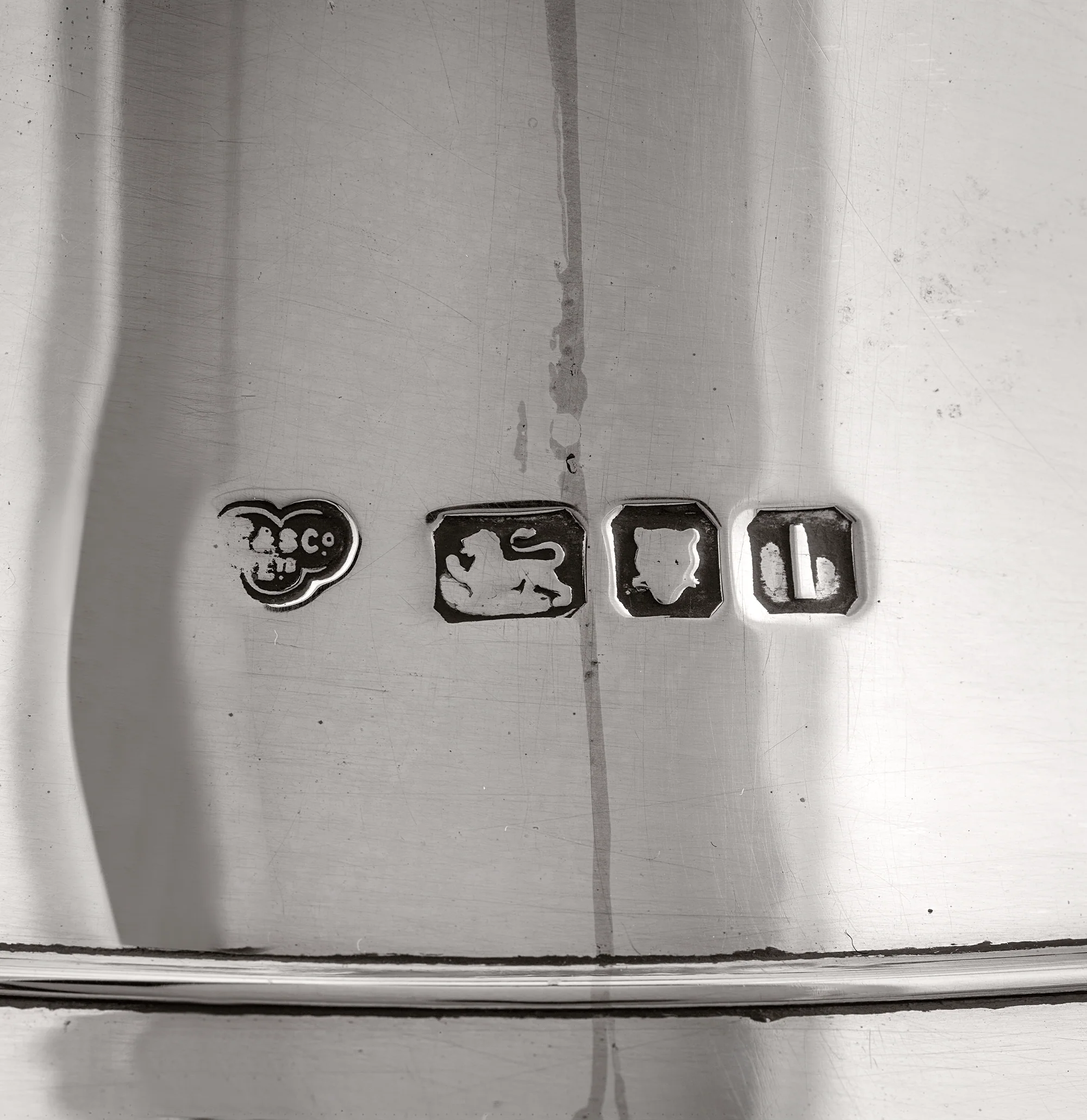
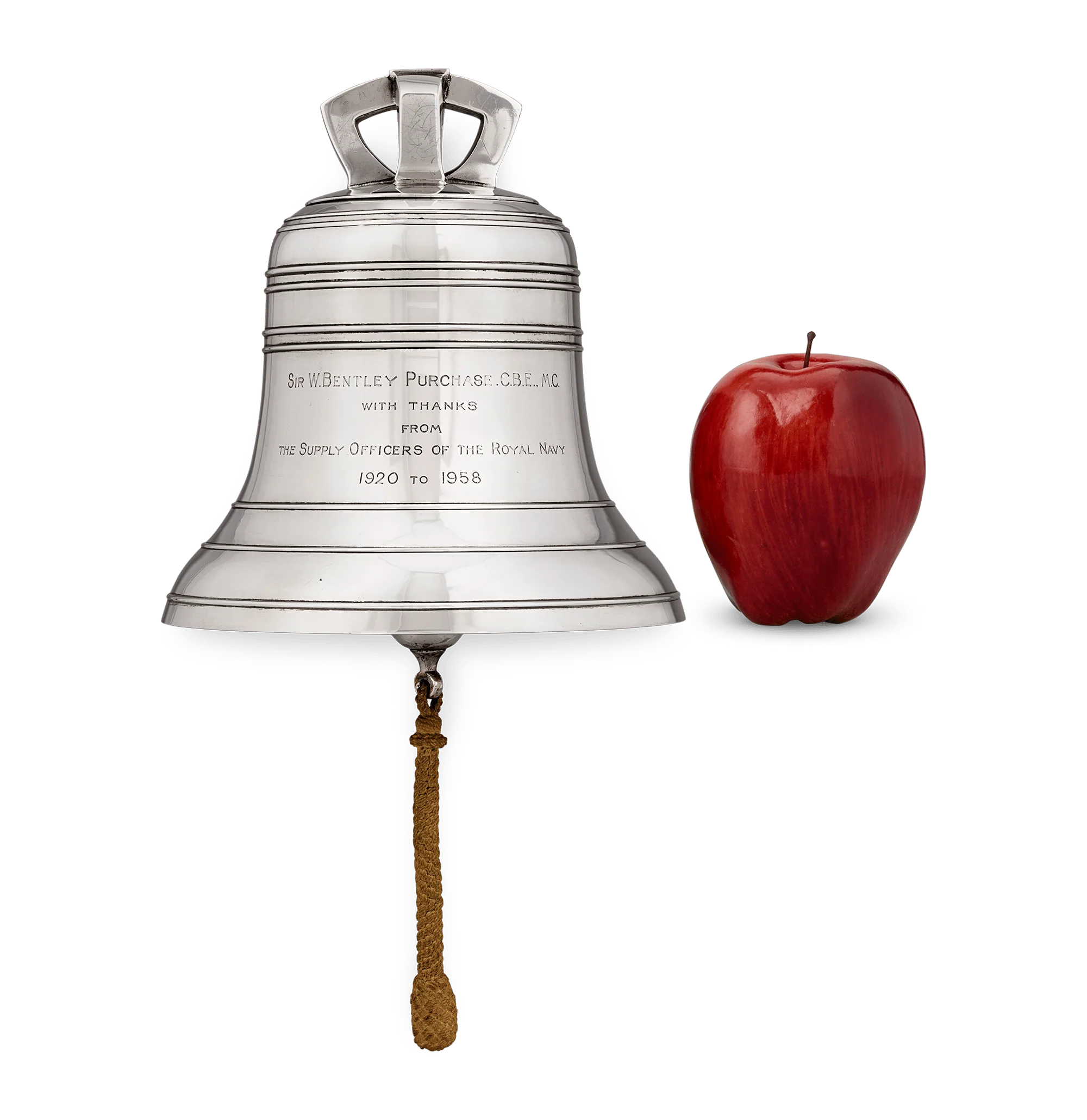
This silver ship’s bell, created by the Goldsmiths & Silversmiths Company, was manufactured in 1944, at a moment when silver production was tightly restricted to official commissions. As a result, any example of silver from this period is exceptionally scarce. Purchase’s role in Operation Mincemeat remained unacknowledged for years, and this bell—commissioned to honor his wartime service and presented upon his knighthood in 1958—stands as the Royal Navy’s formal tribute to his contribution. The bell is engraved: “Sir William Bentley Purchase C.B.E., M.C., with thanks from the supply officers of the Royal Navy 1920 to 1958.”
7 3/4" high x 7" diameter
Presented to Sir William Bentley Purchase
Bell made in 1944, presented in 1958
This remarkable artifact of Second World War history is the silver ship’s bell presented to Sir William Bentley Purchase, the British coroner who played a pivotal role in Operation Mincemeat, one of the most effective intelligence deceptions of the conflict. Commissioned during wartime by the Royal Navy, the bell stands as a rare testament to an operation that altered the course of the Mediterranean campaign by diverting German forces away from Sicily.
Purchase, coroner to the Royal Household, was discreetly called upon by Naval Intelligence in early 1943 to assist in an unprecedented deception. His task was to locate a recently deceased individual whose death would raise no suspicion and whose physical characteristics aligned with those of a staff officer. The body he selected became “Acting Major William Martin,” the fictitious Royal Marines officer, whose cleverly forged documents convinced German intelligence that the materials he carried were genuine.
The selection of the body was no simple task. Previous wartime attempts to use disguised corpses had heightened suspicion, and Naval Intelligence required someone recently deceased, with no visible cause of death, whose passing would not prompt inquiries. On January 28, 1943, Purchase located the ideal candidate: Glyndwr Michael, an unhoused man who died after ingesting rat poison and who was never reported missing. His slight build also suited the profile of a staff officer, and the poison left no trace after what appeared to be several days at sea.
Intelligence officers then constructed a complete identity for “Acting Major William Martin,” dressing the body in battledress and equipping it with convincing personal effects: a photograph of a fictional fiancée, an engagement ring receipt, a family letter and an overdraft notice. Most important were the forged documents outlining Allied plans. The deception worked precisely as intended. German units shifted to Greece and Sardinia, leaving Sicily—the Allies’ actual target—comparatively unprotected.
This silver ship’s bell, created by the Goldsmiths & Silversmiths Company, was manufactured in 1944, at a moment when silver production was tightly restricted to official commissions. As a result, any example of silver from this period is exceptionally scarce. Purchase’s role in Operation Mincemeat remained unacknowledged for years, and this bell—commissioned to honor his wartime service and presented upon his knighthood in 1958—stands as the Royal Navy’s formal tribute to his contribution. The bell is engraved: “Sir William Bentley Purchase C.B.E., M.C., with thanks from the supply officers of the Royal Navy 1920 to 1958.”
7 3/4" high x 7" diameter
$20,475.00
Original: $58,500.00
-65%Silver Ship’s Bell for Sir William Bentley Purchase of Operation Mincemeat—
$58,500.00
$20,475.00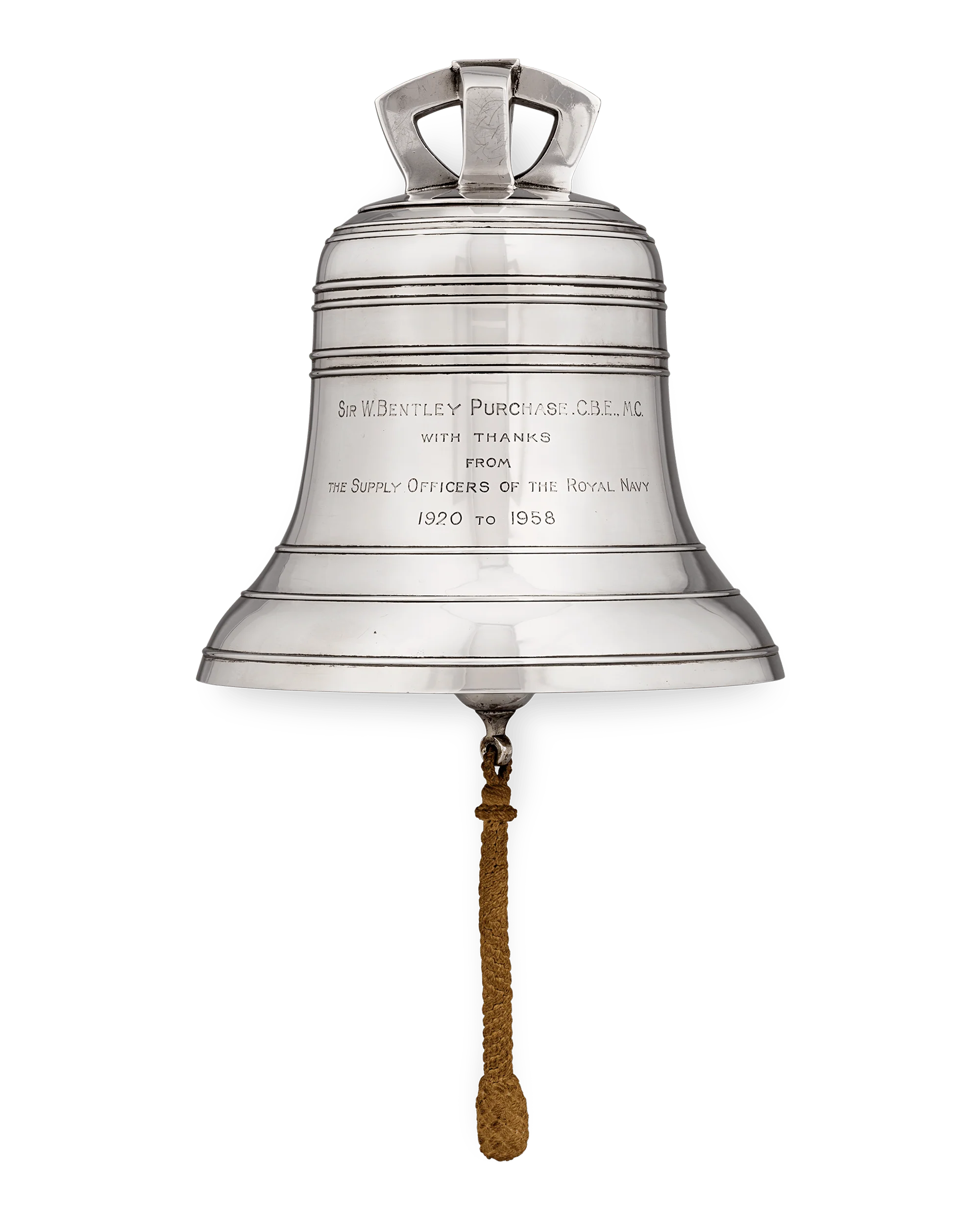
Description
Silver Ship’s Bell
Presented to Sir William Bentley Purchase
Bell made in 1944, presented in 1958
This remarkable artifact of Second World War history is the silver ship’s bell presented to Sir William Bentley Purchase, the British coroner who played a pivotal role in Operation Mincemeat, one of the most effective intelligence deceptions of the conflict. Commissioned during wartime by the Royal Navy, the bell stands as a rare testament to an operation that altered the course of the Mediterranean campaign by diverting German forces away from Sicily.
Purchase, coroner to the Royal Household, was discreetly called upon by Naval Intelligence in early 1943 to assist in an unprecedented deception. His task was to locate a recently deceased individual whose death would raise no suspicion and whose physical characteristics aligned with those of a staff officer. The body he selected became “Acting Major William Martin,” the fictitious Royal Marines officer, whose cleverly forged documents convinced German intelligence that the materials he carried were genuine.
The selection of the body was no simple task. Previous wartime attempts to use disguised corpses had heightened suspicion, and Naval Intelligence required someone recently deceased, with no visible cause of death, whose passing would not prompt inquiries. On January 28, 1943, Purchase located the ideal candidate: Glyndwr Michael, an unhoused man who died after ingesting rat poison and who was never reported missing. His slight build also suited the profile of a staff officer, and the poison left no trace after what appeared to be several days at sea.
Intelligence officers then constructed a complete identity for “Acting Major William Martin,” dressing the body in battledress and equipping it with convincing personal effects: a photograph of a fictional fiancée, an engagement ring receipt, a family letter and an overdraft notice. Most important were the forged documents outlining Allied plans. The deception worked precisely as intended. German units shifted to Greece and Sardinia, leaving Sicily—the Allies’ actual target—comparatively unprotected.
This silver ship’s bell, created by the Goldsmiths & Silversmiths Company, was manufactured in 1944, at a moment when silver production was tightly restricted to official commissions. As a result, any example of silver from this period is exceptionally scarce. Purchase’s role in Operation Mincemeat remained unacknowledged for years, and this bell—commissioned to honor his wartime service and presented upon his knighthood in 1958—stands as the Royal Navy’s formal tribute to his contribution. The bell is engraved: “Sir William Bentley Purchase C.B.E., M.C., with thanks from the supply officers of the Royal Navy 1920 to 1958.”
7 3/4" high x 7" diameter
Presented to Sir William Bentley Purchase
Bell made in 1944, presented in 1958
This remarkable artifact of Second World War history is the silver ship’s bell presented to Sir William Bentley Purchase, the British coroner who played a pivotal role in Operation Mincemeat, one of the most effective intelligence deceptions of the conflict. Commissioned during wartime by the Royal Navy, the bell stands as a rare testament to an operation that altered the course of the Mediterranean campaign by diverting German forces away from Sicily.
Purchase, coroner to the Royal Household, was discreetly called upon by Naval Intelligence in early 1943 to assist in an unprecedented deception. His task was to locate a recently deceased individual whose death would raise no suspicion and whose physical characteristics aligned with those of a staff officer. The body he selected became “Acting Major William Martin,” the fictitious Royal Marines officer, whose cleverly forged documents convinced German intelligence that the materials he carried were genuine.
The selection of the body was no simple task. Previous wartime attempts to use disguised corpses had heightened suspicion, and Naval Intelligence required someone recently deceased, with no visible cause of death, whose passing would not prompt inquiries. On January 28, 1943, Purchase located the ideal candidate: Glyndwr Michael, an unhoused man who died after ingesting rat poison and who was never reported missing. His slight build also suited the profile of a staff officer, and the poison left no trace after what appeared to be several days at sea.
Intelligence officers then constructed a complete identity for “Acting Major William Martin,” dressing the body in battledress and equipping it with convincing personal effects: a photograph of a fictional fiancée, an engagement ring receipt, a family letter and an overdraft notice. Most important were the forged documents outlining Allied plans. The deception worked precisely as intended. German units shifted to Greece and Sardinia, leaving Sicily—the Allies’ actual target—comparatively unprotected.
This silver ship’s bell, created by the Goldsmiths & Silversmiths Company, was manufactured in 1944, at a moment when silver production was tightly restricted to official commissions. As a result, any example of silver from this period is exceptionally scarce. Purchase’s role in Operation Mincemeat remained unacknowledged for years, and this bell—commissioned to honor his wartime service and presented upon his knighthood in 1958—stands as the Royal Navy’s formal tribute to his contribution. The bell is engraved: “Sir William Bentley Purchase C.B.E., M.C., with thanks from the supply officers of the Royal Navy 1920 to 1958.”
7 3/4" high x 7" diameter