🎉 Up to 70% Off Selected ItemsShop Sale

Tabarin by Erté
Erté (Romain de Tirtoff)
1892-1990 | Russian-French
Tabarin
Signed “Erté”(lower right)
Inscribed "Dédicacée à Serge Leeman" (en verso)
Gouache on paper
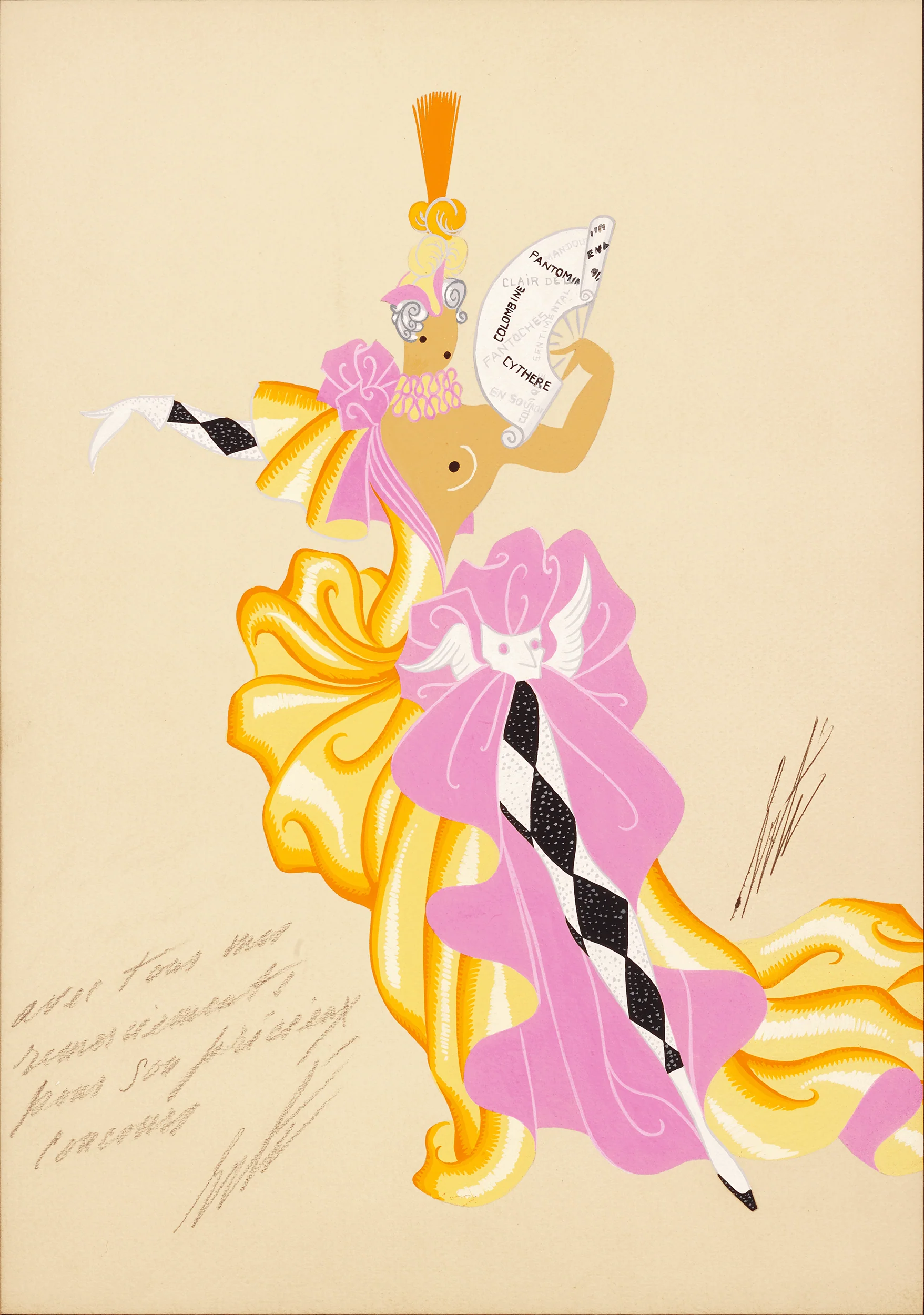
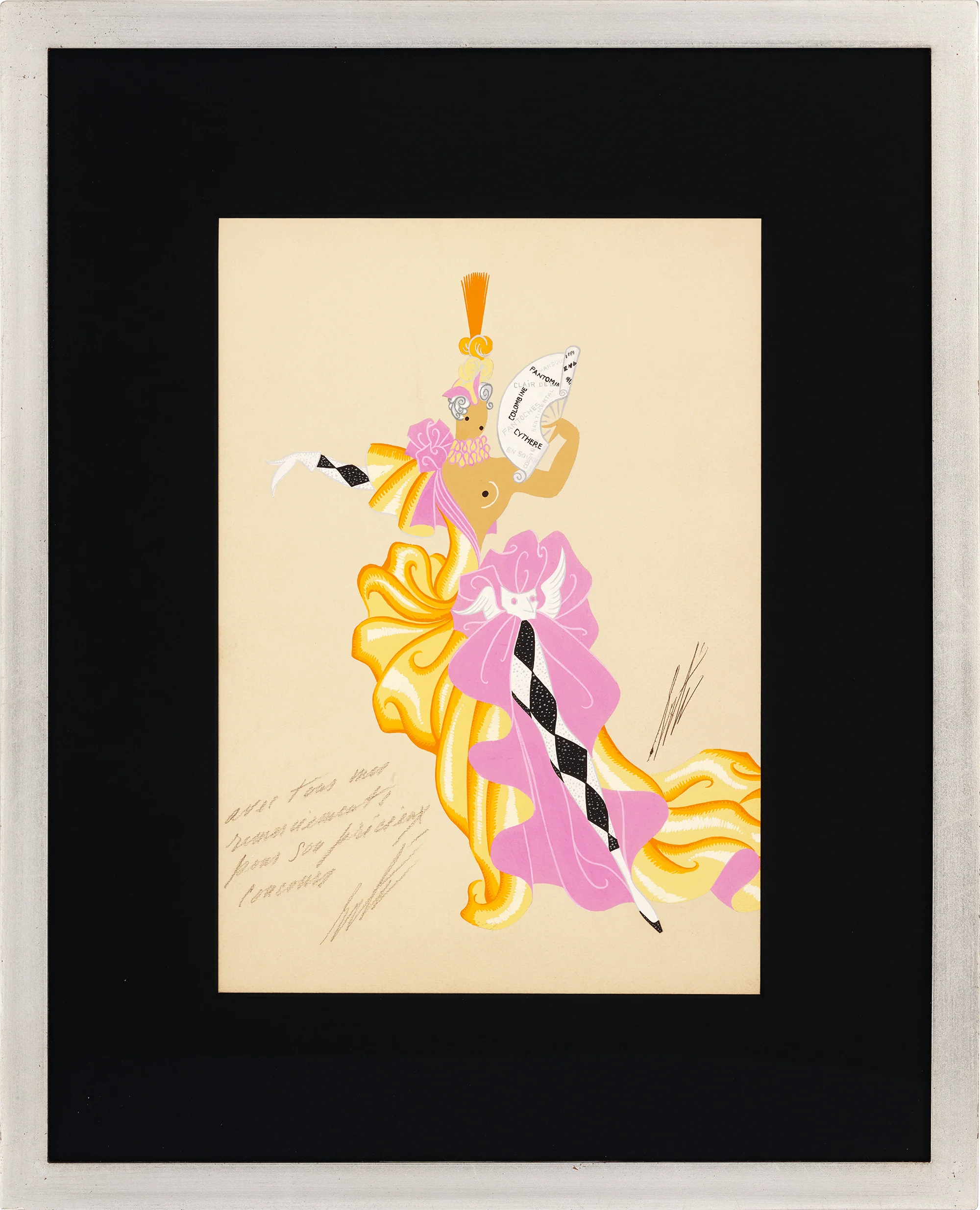
This costume design for a 1940 cabaret production of La Comédie italienne entitled Tabarin showcases Erté's reinterpretation the iconic Commedia dell'arte character. The stock character Tabarin, with his distinctive attire featuring an exaggerated hat and eccentric outfit, has deep theatrical and historical significance, influencing the aesthetics of theater and fashion even in the modern era. Erte's whimsical Art Deco take on Tabarin combines elements of a jester's black and white costume with a flowing yellow gown. This combination offers elegant yet enigmatic commentary that certainly resonated with the Art Deco and cabaret milieu.
Russian-French visionary Romain de Tirtoff (1892-1990), popularly known as Erté, began his artistic journey in the culturally rich city of St. Petersburg, where he developed an early fondness for ballet and theatrical performances. He moved to Paris in 1912 to study architecture, and quickly found his creative niche in crafting fantastical costumes for the city’s bustling nightlife. Erté‘s expertise, refined under the guidance of the famed Paul Poiret, captured the attention of Harper’s Bazaar, marking the beginning of a significant partnership that spanned from 1915 to 1936. The artist also designed sets for notable cinematic masterpieces including Ben Hur and La Bohème, and created sets and costumes for cabarets, operas and other performances at the Folies-Bergères, Bal Tabarin, the Théâtre du Bataclan and Le Casino de Paris. Often remembered as the “Father of Art Deco,” Erté was a trailblazer whose colorful creations shaped the groundbreaking Art Deco era more than any other, leaving an indelible mark on the history of art and design. His artworks reside in prestigious museum collections worldwide, including the Metropolitan Museum of Art in New York, the Victoria & Albert Museum in London and the Los Angeles County Museum of Art.
Circa 1940
Paper: 14” high by 10” wide
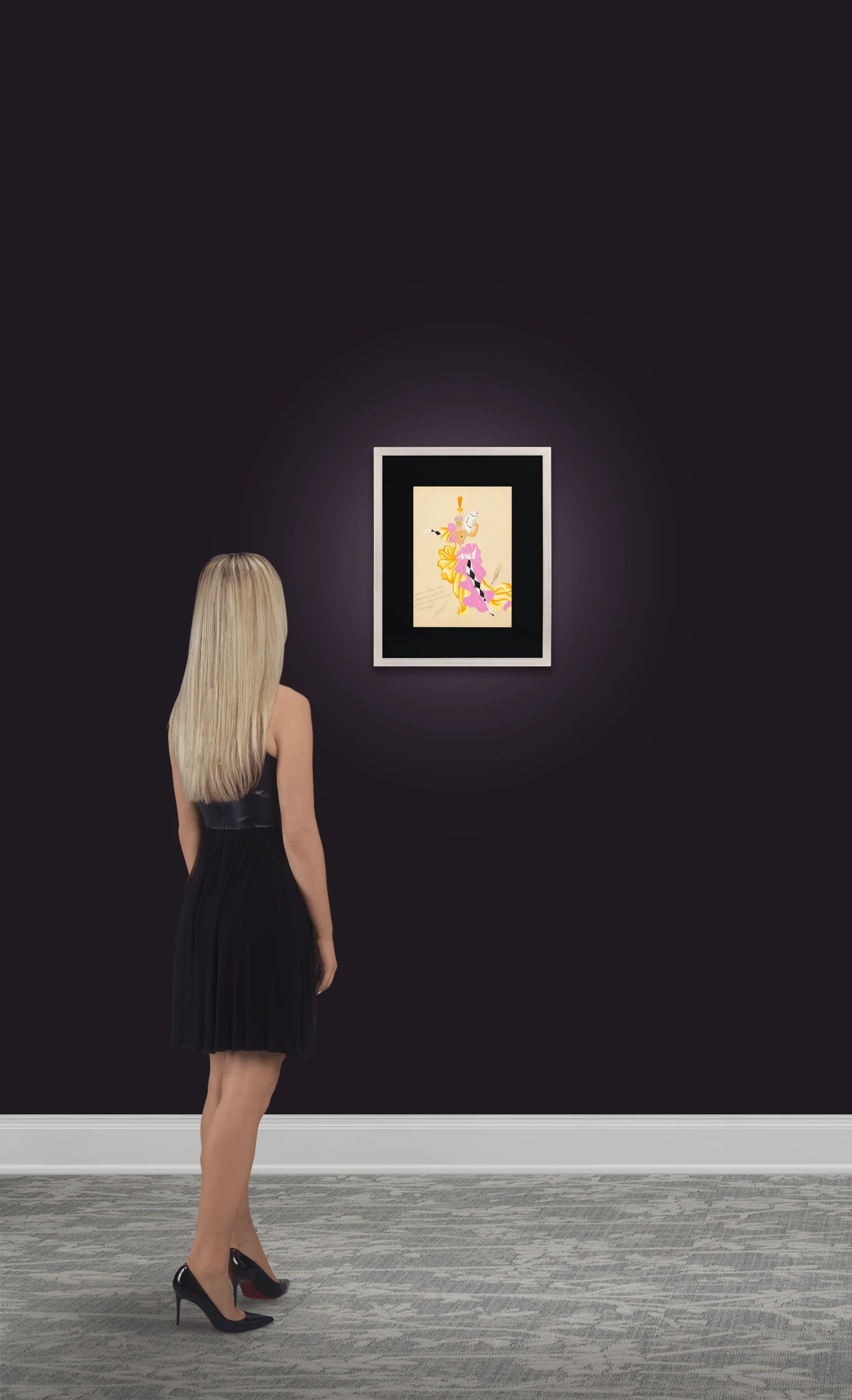
Frame: 20 3/4” high by 16 7/8” wide by 5/8" deep
Exhibitions:
M.S. Rau, New Orleans, Erté and the Era of Art Deco, October 14, 2023 - January 3, 2024
Provenance:
Serge Leeman, Paris
Private collection, Paris
M.S. Rau, New Orleans
1892-1990 | Russian-French
Tabarin
Signed “Erté”(lower right)
Inscribed "Dédicacée à Serge Leeman" (en verso)
Gouache on paper
This costume design for a 1940 cabaret production of La Comédie italienne entitled Tabarin showcases Erté's reinterpretation the iconic Commedia dell'arte character. The stock character Tabarin, with his distinctive attire featuring an exaggerated hat and eccentric outfit, has deep theatrical and historical significance, influencing the aesthetics of theater and fashion even in the modern era. Erte's whimsical Art Deco take on Tabarin combines elements of a jester's black and white costume with a flowing yellow gown. This combination offers elegant yet enigmatic commentary that certainly resonated with the Art Deco and cabaret milieu.
Russian-French visionary Romain de Tirtoff (1892-1990), popularly known as Erté, began his artistic journey in the culturally rich city of St. Petersburg, where he developed an early fondness for ballet and theatrical performances. He moved to Paris in 1912 to study architecture, and quickly found his creative niche in crafting fantastical costumes for the city’s bustling nightlife. Erté‘s expertise, refined under the guidance of the famed Paul Poiret, captured the attention of Harper’s Bazaar, marking the beginning of a significant partnership that spanned from 1915 to 1936. The artist also designed sets for notable cinematic masterpieces including Ben Hur and La Bohème, and created sets and costumes for cabarets, operas and other performances at the Folies-Bergères, Bal Tabarin, the Théâtre du Bataclan and Le Casino de Paris. Often remembered as the “Father of Art Deco,” Erté was a trailblazer whose colorful creations shaped the groundbreaking Art Deco era more than any other, leaving an indelible mark on the history of art and design. His artworks reside in prestigious museum collections worldwide, including the Metropolitan Museum of Art in New York, the Victoria & Albert Museum in London and the Los Angeles County Museum of Art.
Circa 1940
Paper: 14” high by 10” wide
Frame: 20 3/4” high by 16 7/8” wide by 5/8" deep
Exhibitions:
M.S. Rau, New Orleans, Erté and the Era of Art Deco, October 14, 2023 - January 3, 2024
Provenance:
Serge Leeman, Paris
Private collection, Paris
M.S. Rau, New Orleans
$22,500.00
Tabarin by Erté—
$22,500.00
Description
Erté (Romain de Tirtoff)
1892-1990 | Russian-French
Tabarin
Signed “Erté”(lower right)
Inscribed "Dédicacée à Serge Leeman" (en verso)
Gouache on paper
This costume design for a 1940 cabaret production of La Comédie italienne entitled Tabarin showcases Erté's reinterpretation the iconic Commedia dell'arte character. The stock character Tabarin, with his distinctive attire featuring an exaggerated hat and eccentric outfit, has deep theatrical and historical significance, influencing the aesthetics of theater and fashion even in the modern era. Erte's whimsical Art Deco take on Tabarin combines elements of a jester's black and white costume with a flowing yellow gown. This combination offers elegant yet enigmatic commentary that certainly resonated with the Art Deco and cabaret milieu.
Russian-French visionary Romain de Tirtoff (1892-1990), popularly known as Erté, began his artistic journey in the culturally rich city of St. Petersburg, where he developed an early fondness for ballet and theatrical performances. He moved to Paris in 1912 to study architecture, and quickly found his creative niche in crafting fantastical costumes for the city’s bustling nightlife. Erté‘s expertise, refined under the guidance of the famed Paul Poiret, captured the attention of Harper’s Bazaar, marking the beginning of a significant partnership that spanned from 1915 to 1936. The artist also designed sets for notable cinematic masterpieces including Ben Hur and La Bohème, and created sets and costumes for cabarets, operas and other performances at the Folies-Bergères, Bal Tabarin, the Théâtre du Bataclan and Le Casino de Paris. Often remembered as the “Father of Art Deco,” Erté was a trailblazer whose colorful creations shaped the groundbreaking Art Deco era more than any other, leaving an indelible mark on the history of art and design. His artworks reside in prestigious museum collections worldwide, including the Metropolitan Museum of Art in New York, the Victoria & Albert Museum in London and the Los Angeles County Museum of Art.
Circa 1940
Paper: 14” high by 10” wide
Frame: 20 3/4” high by 16 7/8” wide by 5/8" deep
Exhibitions:
M.S. Rau, New Orleans, Erté and the Era of Art Deco, October 14, 2023 - January 3, 2024
Provenance:
Serge Leeman, Paris
Private collection, Paris
M.S. Rau, New Orleans
1892-1990 | Russian-French
Tabarin
Signed “Erté”(lower right)
Inscribed "Dédicacée à Serge Leeman" (en verso)
Gouache on paper
This costume design for a 1940 cabaret production of La Comédie italienne entitled Tabarin showcases Erté's reinterpretation the iconic Commedia dell'arte character. The stock character Tabarin, with his distinctive attire featuring an exaggerated hat and eccentric outfit, has deep theatrical and historical significance, influencing the aesthetics of theater and fashion even in the modern era. Erte's whimsical Art Deco take on Tabarin combines elements of a jester's black and white costume with a flowing yellow gown. This combination offers elegant yet enigmatic commentary that certainly resonated with the Art Deco and cabaret milieu.
Russian-French visionary Romain de Tirtoff (1892-1990), popularly known as Erté, began his artistic journey in the culturally rich city of St. Petersburg, where he developed an early fondness for ballet and theatrical performances. He moved to Paris in 1912 to study architecture, and quickly found his creative niche in crafting fantastical costumes for the city’s bustling nightlife. Erté‘s expertise, refined under the guidance of the famed Paul Poiret, captured the attention of Harper’s Bazaar, marking the beginning of a significant partnership that spanned from 1915 to 1936. The artist also designed sets for notable cinematic masterpieces including Ben Hur and La Bohème, and created sets and costumes for cabarets, operas and other performances at the Folies-Bergères, Bal Tabarin, the Théâtre du Bataclan and Le Casino de Paris. Often remembered as the “Father of Art Deco,” Erté was a trailblazer whose colorful creations shaped the groundbreaking Art Deco era more than any other, leaving an indelible mark on the history of art and design. His artworks reside in prestigious museum collections worldwide, including the Metropolitan Museum of Art in New York, the Victoria & Albert Museum in London and the Los Angeles County Museum of Art.
Circa 1940
Paper: 14” high by 10” wide
Frame: 20 3/4” high by 16 7/8” wide by 5/8" deep
Exhibitions:
M.S. Rau, New Orleans, Erté and the Era of Art Deco, October 14, 2023 - January 3, 2024
Provenance:
Serge Leeman, Paris
Private collection, Paris
M.S. Rau, New Orleans