🎉 Up to 70% Off Selected ItemsShop Sale

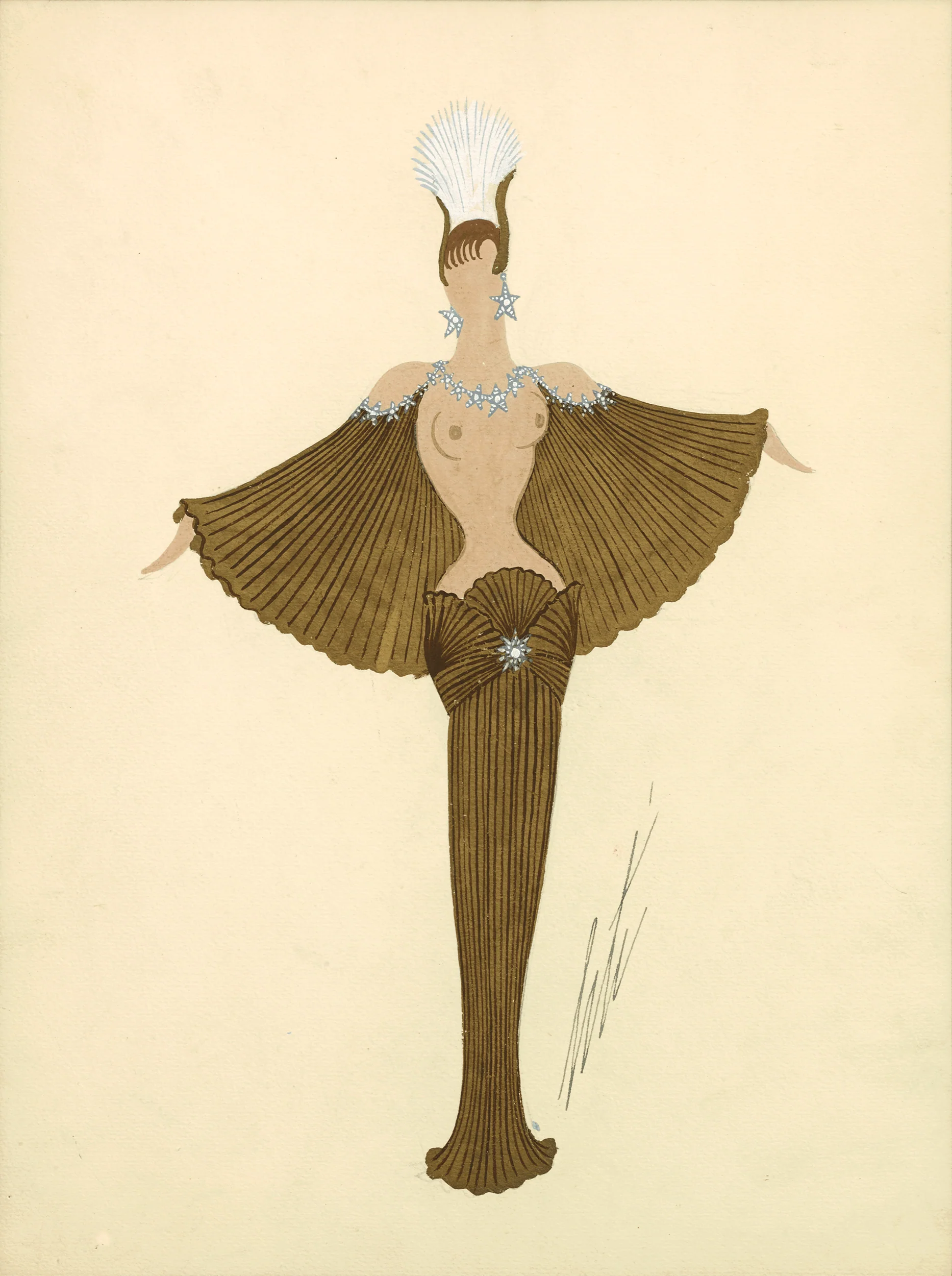
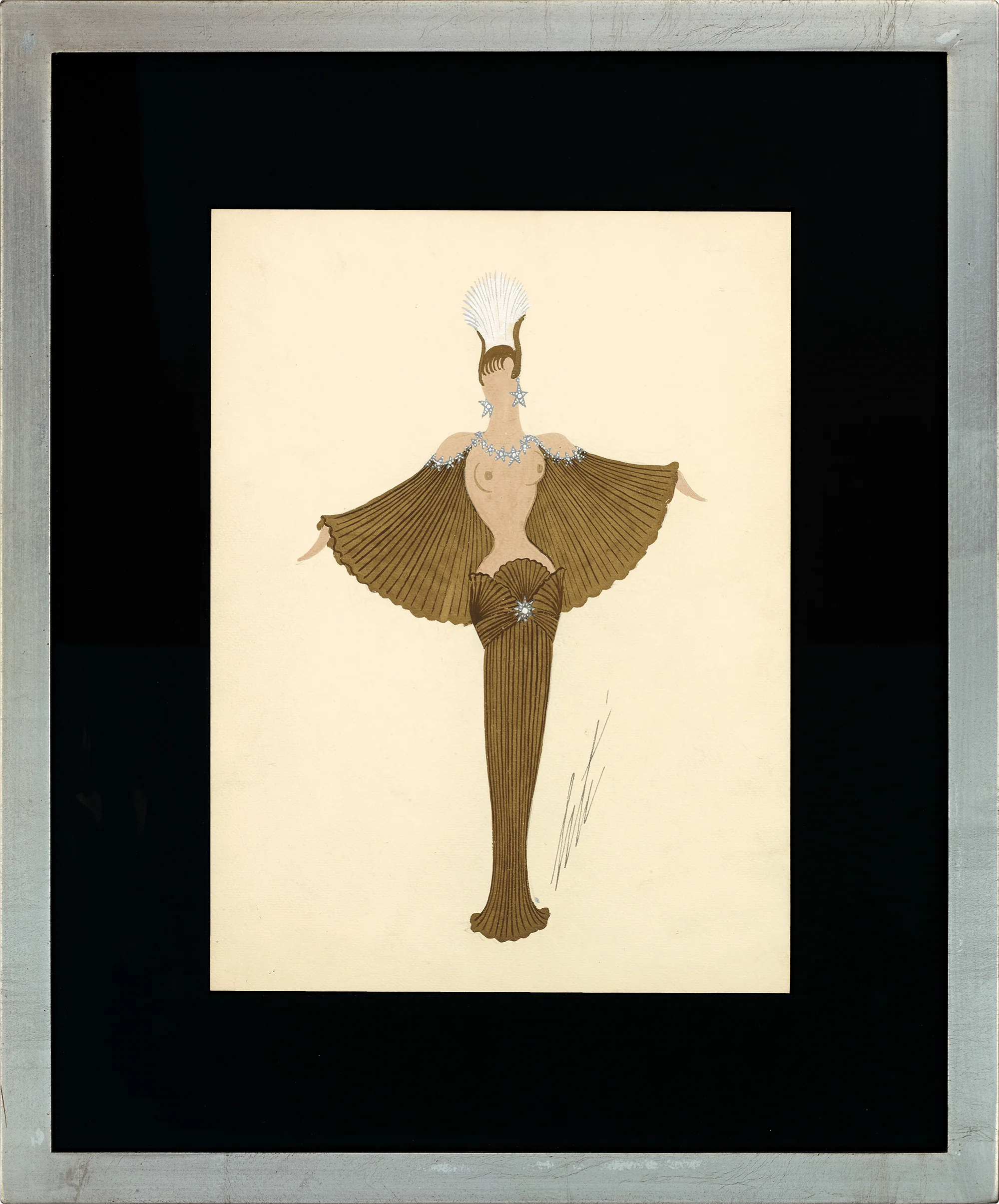
Une étoile de Hollywood I by Erté
Erté (Romain de Tirtoff)
1892-1990 | Russian-French
Une étoile de Hollywood I (Hollywood Star I)
Signed “Erté” (lower right)
Inscribed "No. 12.449 / La Lyre (1er mannequin)" (en verso) Gouache on paper
In Une étoile de Hollywood I, Erté adeptly renders a design that is both glamorous and timeless. The design hails from a series of ensembles and exemplifies Erte’s dexterity in blending his Art Deco aesthetics with high fashion. Lavishly detailed with a golden hue, each gown’s form-fitting silhouette accentuates the figure. Hollywood, since its inception in the early 20th century, has been the bedrock of cinematic innovation. As the American film industry rapidly grew, so did its unique system of promoting its leading actors and actresses, creating the concept of “stardom.” Following his tenure with MGM, Erté was intimately familiar with the glamour and opulence of the silver screen’s earliest celebrities.
Fashion underwent a radical transformation in the Art Deco period. The designs of Coco Chanel, Elsa Schiaparelli, and Jean Patou, characterized by their boldness and modernity, redefined feminine style. The couture houses of the Avenue Montaigne and Rue du Faubourg Saint-Honoré set global trends, making Paris the undisputed capital of fashion. High society flocked to opulent parties and balls, with the city’s elite showcasing the latest haute couture creations. Erté’s sartorial masterpieces found acclaim among many fashionistas and socialites, who often viewed his designs in publications including Harper’s Bazaar.
Russian-French visionary Romain de Tirtoff (1892-1990), popularly known as Erté, began his artistic journey in the culturally rich city of St. Petersburg, where he developed an early fondness for ballet and theatrical performances. He moved to Paris in 1912 to study architecture, and quickly found his creative niche in crafting fantastical costumes for the city’s bustling nightlife. Erté‘s expertise, refined under the guidance of the famed Paul Poiret, captured the attention of Harper’s Bazaar, marking the beginning of a significant partnership that spanned from 1915 to 1936. The artist also designed sets for notable cinematic masterpieces including Ben Hur and La Bohème, and created sets and costumes for cabarets, operas and other performances at the Folies-Bergères, Bal Tabarin, the Théâtre du Bataclan and Le Casino de Paris. Often remembered as the “Father of Art Deco,” Erté was a trailblazer whose colorful creations shaped the groundbreaking Art Deco era more than any other, leaving an indelible mark on the history of art and design. His artworks reside in prestigious museum collections worldwide, including the Metropolitan Museum of Art in New York, the Victoria & Albert Museum in London and the Los Angeles County Museum of Art.
Painted 1952
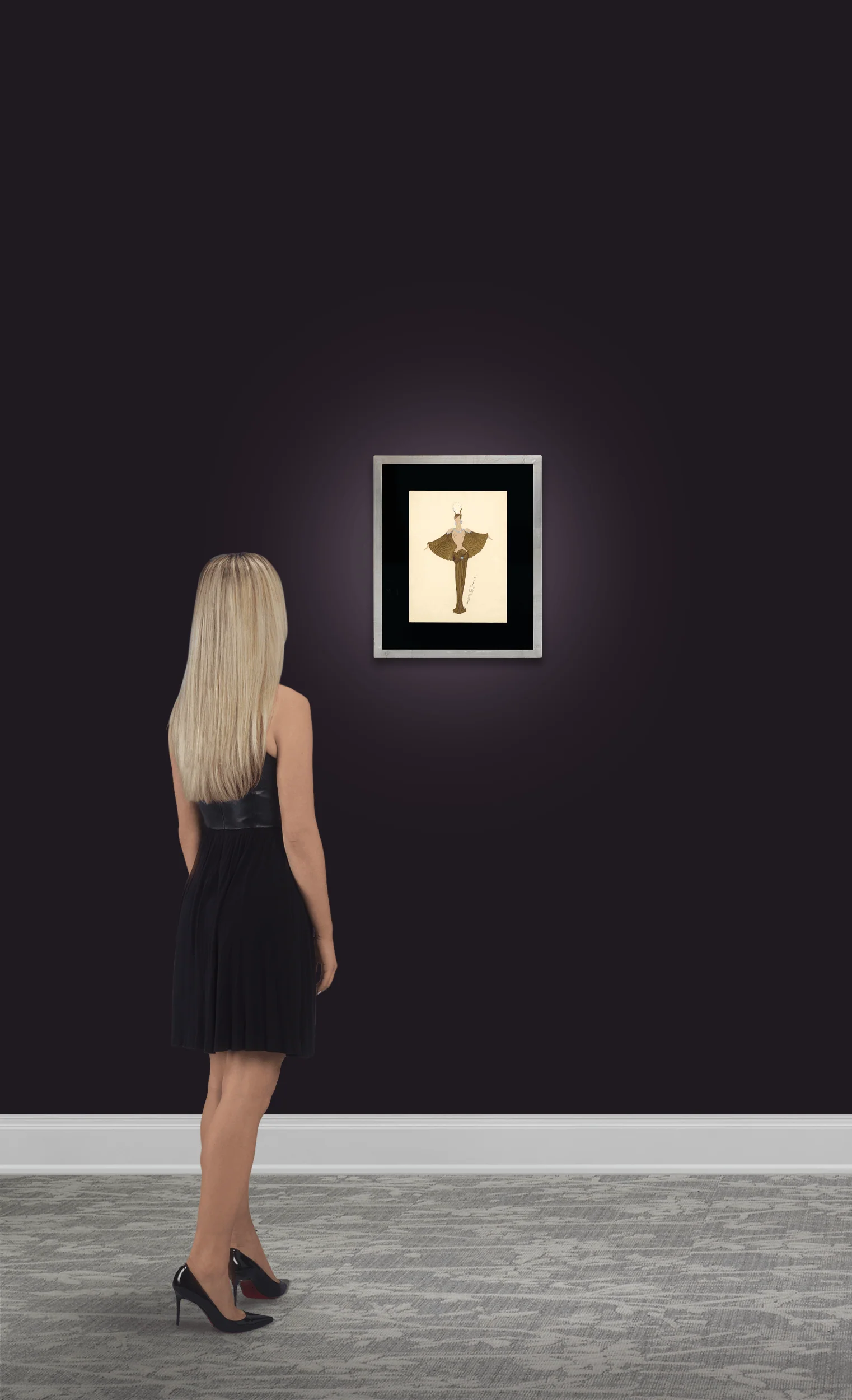
Paper: 13" high x 10" wide
Frame: 19 1/4" high x 16 1/8" wide x 5/8" deep
Exhibitions:
M.S. Rau, New Orleans, Erté and the Era of Art Deco, October 14, 2023 - January 3, 2024
Provenance:
Private collection, Paris
M.S. Rau, New Orleans
1892-1990 | Russian-French
Une étoile de Hollywood I (Hollywood Star I)
Signed “Erté” (lower right)
Inscribed "No. 12.449 / La Lyre (1er mannequin)" (en verso) Gouache on paper
In Une étoile de Hollywood I, Erté adeptly renders a design that is both glamorous and timeless. The design hails from a series of ensembles and exemplifies Erte’s dexterity in blending his Art Deco aesthetics with high fashion. Lavishly detailed with a golden hue, each gown’s form-fitting silhouette accentuates the figure. Hollywood, since its inception in the early 20th century, has been the bedrock of cinematic innovation. As the American film industry rapidly grew, so did its unique system of promoting its leading actors and actresses, creating the concept of “stardom.” Following his tenure with MGM, Erté was intimately familiar with the glamour and opulence of the silver screen’s earliest celebrities.
Fashion underwent a radical transformation in the Art Deco period. The designs of Coco Chanel, Elsa Schiaparelli, and Jean Patou, characterized by their boldness and modernity, redefined feminine style. The couture houses of the Avenue Montaigne and Rue du Faubourg Saint-Honoré set global trends, making Paris the undisputed capital of fashion. High society flocked to opulent parties and balls, with the city’s elite showcasing the latest haute couture creations. Erté’s sartorial masterpieces found acclaim among many fashionistas and socialites, who often viewed his designs in publications including Harper’s Bazaar.
Russian-French visionary Romain de Tirtoff (1892-1990), popularly known as Erté, began his artistic journey in the culturally rich city of St. Petersburg, where he developed an early fondness for ballet and theatrical performances. He moved to Paris in 1912 to study architecture, and quickly found his creative niche in crafting fantastical costumes for the city’s bustling nightlife. Erté‘s expertise, refined under the guidance of the famed Paul Poiret, captured the attention of Harper’s Bazaar, marking the beginning of a significant partnership that spanned from 1915 to 1936. The artist also designed sets for notable cinematic masterpieces including Ben Hur and La Bohème, and created sets and costumes for cabarets, operas and other performances at the Folies-Bergères, Bal Tabarin, the Théâtre du Bataclan and Le Casino de Paris. Often remembered as the “Father of Art Deco,” Erté was a trailblazer whose colorful creations shaped the groundbreaking Art Deco era more than any other, leaving an indelible mark on the history of art and design. His artworks reside in prestigious museum collections worldwide, including the Metropolitan Museum of Art in New York, the Victoria & Albert Museum in London and the Los Angeles County Museum of Art.
Painted 1952
Paper: 13" high x 10" wide
Frame: 19 1/4" high x 16 1/8" wide x 5/8" deep
Exhibitions:
M.S. Rau, New Orleans, Erté and the Era of Art Deco, October 14, 2023 - January 3, 2024
Provenance:
Private collection, Paris
M.S. Rau, New Orleans
$16,500.00
Une étoile de Hollywood I by Erté—
$16,500.00
Description
Erté (Romain de Tirtoff)
1892-1990 | Russian-French
Une étoile de Hollywood I (Hollywood Star I)
Signed “Erté” (lower right)
Inscribed "No. 12.449 / La Lyre (1er mannequin)" (en verso) Gouache on paper
In Une étoile de Hollywood I, Erté adeptly renders a design that is both glamorous and timeless. The design hails from a series of ensembles and exemplifies Erte’s dexterity in blending his Art Deco aesthetics with high fashion. Lavishly detailed with a golden hue, each gown’s form-fitting silhouette accentuates the figure. Hollywood, since its inception in the early 20th century, has been the bedrock of cinematic innovation. As the American film industry rapidly grew, so did its unique system of promoting its leading actors and actresses, creating the concept of “stardom.” Following his tenure with MGM, Erté was intimately familiar with the glamour and opulence of the silver screen’s earliest celebrities.
Fashion underwent a radical transformation in the Art Deco period. The designs of Coco Chanel, Elsa Schiaparelli, and Jean Patou, characterized by their boldness and modernity, redefined feminine style. The couture houses of the Avenue Montaigne and Rue du Faubourg Saint-Honoré set global trends, making Paris the undisputed capital of fashion. High society flocked to opulent parties and balls, with the city’s elite showcasing the latest haute couture creations. Erté’s sartorial masterpieces found acclaim among many fashionistas and socialites, who often viewed his designs in publications including Harper’s Bazaar.
Russian-French visionary Romain de Tirtoff (1892-1990), popularly known as Erté, began his artistic journey in the culturally rich city of St. Petersburg, where he developed an early fondness for ballet and theatrical performances. He moved to Paris in 1912 to study architecture, and quickly found his creative niche in crafting fantastical costumes for the city’s bustling nightlife. Erté‘s expertise, refined under the guidance of the famed Paul Poiret, captured the attention of Harper’s Bazaar, marking the beginning of a significant partnership that spanned from 1915 to 1936. The artist also designed sets for notable cinematic masterpieces including Ben Hur and La Bohème, and created sets and costumes for cabarets, operas and other performances at the Folies-Bergères, Bal Tabarin, the Théâtre du Bataclan and Le Casino de Paris. Often remembered as the “Father of Art Deco,” Erté was a trailblazer whose colorful creations shaped the groundbreaking Art Deco era more than any other, leaving an indelible mark on the history of art and design. His artworks reside in prestigious museum collections worldwide, including the Metropolitan Museum of Art in New York, the Victoria & Albert Museum in London and the Los Angeles County Museum of Art.
Painted 1952
Paper: 13" high x 10" wide
Frame: 19 1/4" high x 16 1/8" wide x 5/8" deep
Exhibitions:
M.S. Rau, New Orleans, Erté and the Era of Art Deco, October 14, 2023 - January 3, 2024
Provenance:
Private collection, Paris
M.S. Rau, New Orleans
1892-1990 | Russian-French
Une étoile de Hollywood I (Hollywood Star I)
Signed “Erté” (lower right)
Inscribed "No. 12.449 / La Lyre (1er mannequin)" (en verso) Gouache on paper
In Une étoile de Hollywood I, Erté adeptly renders a design that is both glamorous and timeless. The design hails from a series of ensembles and exemplifies Erte’s dexterity in blending his Art Deco aesthetics with high fashion. Lavishly detailed with a golden hue, each gown’s form-fitting silhouette accentuates the figure. Hollywood, since its inception in the early 20th century, has been the bedrock of cinematic innovation. As the American film industry rapidly grew, so did its unique system of promoting its leading actors and actresses, creating the concept of “stardom.” Following his tenure with MGM, Erté was intimately familiar with the glamour and opulence of the silver screen’s earliest celebrities.
Fashion underwent a radical transformation in the Art Deco period. The designs of Coco Chanel, Elsa Schiaparelli, and Jean Patou, characterized by their boldness and modernity, redefined feminine style. The couture houses of the Avenue Montaigne and Rue du Faubourg Saint-Honoré set global trends, making Paris the undisputed capital of fashion. High society flocked to opulent parties and balls, with the city’s elite showcasing the latest haute couture creations. Erté’s sartorial masterpieces found acclaim among many fashionistas and socialites, who often viewed his designs in publications including Harper’s Bazaar.
Russian-French visionary Romain de Tirtoff (1892-1990), popularly known as Erté, began his artistic journey in the culturally rich city of St. Petersburg, where he developed an early fondness for ballet and theatrical performances. He moved to Paris in 1912 to study architecture, and quickly found his creative niche in crafting fantastical costumes for the city’s bustling nightlife. Erté‘s expertise, refined under the guidance of the famed Paul Poiret, captured the attention of Harper’s Bazaar, marking the beginning of a significant partnership that spanned from 1915 to 1936. The artist also designed sets for notable cinematic masterpieces including Ben Hur and La Bohème, and created sets and costumes for cabarets, operas and other performances at the Folies-Bergères, Bal Tabarin, the Théâtre du Bataclan and Le Casino de Paris. Often remembered as the “Father of Art Deco,” Erté was a trailblazer whose colorful creations shaped the groundbreaking Art Deco era more than any other, leaving an indelible mark on the history of art and design. His artworks reside in prestigious museum collections worldwide, including the Metropolitan Museum of Art in New York, the Victoria & Albert Museum in London and the Los Angeles County Museum of Art.
Painted 1952
Paper: 13" high x 10" wide
Frame: 19 1/4" high x 16 1/8" wide x 5/8" deep
Exhibitions:
M.S. Rau, New Orleans, Erté and the Era of Art Deco, October 14, 2023 - January 3, 2024
Provenance:
Private collection, Paris
M.S. Rau, New Orleans